
By Janine Thomson, REALTOR® | Pemberton Holmes
Greater Victoria and Vancouver Island Real Estate
 Updated July 31, 2026
When buying or selling a home in British Columbia, the purchase price is only part of the financial picture. Both buyers and sellers may face additional expenses before a real estate transaction is completed.
These expenses are commonly called closing costs. They can include Property Transfer Tax, legal or notary fees, mortgage expenses, property-tax adjustments, strata costs, real estate commission, insurance and other transaction-related charges.
Understanding your potential closing costs before entering into a contract can help you:
- Establish a realistic purchasing budget
- Estimate the net proceeds from a sale
- Avoid last-minute financial surprises
- Keep funds accessible before completion
- Determine whether a particular property is affordable
- Compare resale properties with new construction
For more home-buying and selling information, visit my complete collection of Greater Victoria buyer and seller resources.
What Are Closing Costs in a BC Real Estate Transaction?
Closing costs are the expenses associated with legally and financially completing a property purchase or sale.In British Columbia, the term “closing” generally refers to the completion date, the date the buyer’s funds are transferred, the seller’s existing financial charges are addressed and ownership is registered in the buyer’s name.The completion date should not be confused with the possession date. Possession is when the buyer is entitled to enter the property and receive the keys. Possession often occurs after completion, although the dates are established in the Contract of Purchase and Sale.
The adjustment date determines how certain expenses, such as property taxes, strata fees, rents or utilities, are divided between the buyer and seller.Your lawyer or notary calculates these amounts and prepares a statement showing the applicable credits, debits and funds required to complete the transaction.
These are general practices. The actual allocation of expenses depends on the contract, the property, the parties’ circumstances and applicable legislation.
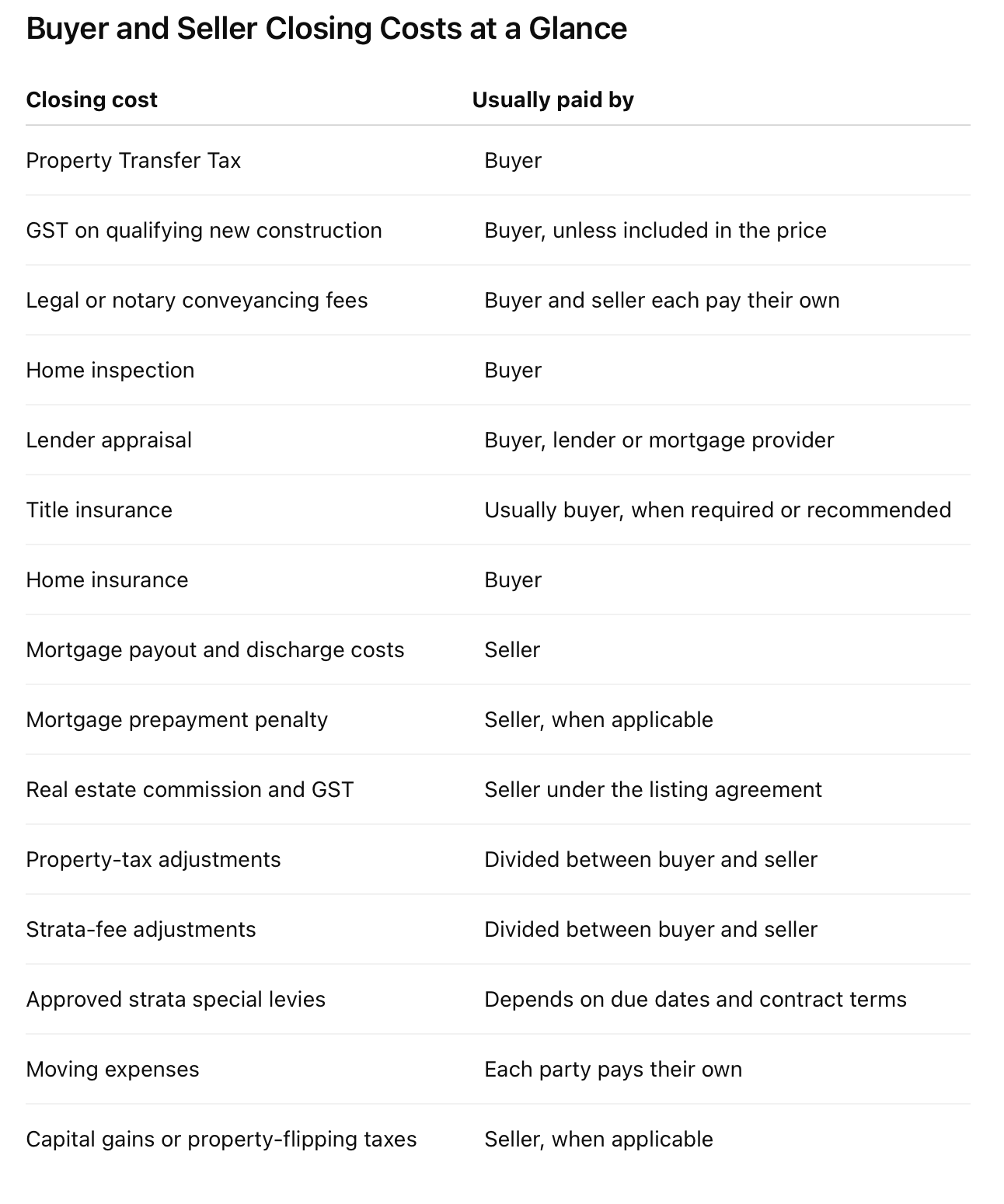
These are general practices. The actual allocation of expenses depends on the contract, the property, the parties’ circumstances and applicable legislation.
Closing Costs for Buyers in British Columbia
1. Property Transfer Tax
Property Transfer Tax, or PTT, is one of the largest closing costs for many B.C. home buyers.The tax is generally based on the property’s fair market value on the date ownership is registered at the Land Title Office. In a conventional arm’s-length sale, the purchase price is often, but not always, accepted as the fair market value.
The current general Property Transfer Tax rates are:
- 1% on the first $200,000
- 2% on the portion above $200,000 and up to $2 million
- 3% on the portion above $2 million
- A further 2% on the residential portion above $3 million
Example: Property Transfer Tax on a $750,000 Home
For a resale home purchased for $750,000:- 1% of the first $200,000 = $2,000
- 2% of the remaining $550,000 = $11,000
- Total Property Transfer Tax = $13,000
2. First-Time Home Buyers’ Property Transfer Tax Exemption
B.C.’s First Time Home Buyers’ Program can reduce or eliminate Property Transfer Tax for qualifying purchasers.As of 2026:
- At $500,000 or less, a qualifying buyer may receive a full exemption.
- Above $500,000 and up to $835,000, the maximum exemption is $8,000.
- Above $835,000 and below $860,000, the exemption is proportionately reduced.
- At $860,000 or more, the exemption is unavailable.
For example, a qualifying first-time buyer purchasing a $750,000 home would normally have $13,000 in Property Transfer Tax before the exemption. After the maximum $8,000 exemption, the buyer would still pay approximately $5,000.
Additional eligibility requirements apply, including requirements concerning:
- Canadian citizenship or permanent residency
- Previous homeownership
- B.C. residency or tax filing
- Principal-residence occupancy
- Property size
- Residential use
- The percentage of ownership held by each purchaser
3. Newly Built Home Property Transfer Tax Exemption
Buyers of qualifying newly built principal residences may be eligible for a separate Property Transfer Tax exemption.As of 2026:
- A full exemption may be available when the property’s fair market value is $1.1 million or less.
- A partial exemption may be available above $1.1 million and below $1.15 million.
- The exemption is unavailable at $1.15 million or more.
The newly built home exemption is separate from GST. Qualifying for a Property Transfer Tax exemption does not automatically exempt the purchase from GST.
4. GST on New Construction and Substantially Renovated Homes
GST generally applies at a rate of 5% to:- Newly constructed homes
- New condominium units
- New townhouses
- Pre-sale properties
- Certain substantially renovated homes
- Some assignment transactions
- Certain properties previously used for short-term accommodation or commercial purposes
Before purchasing a new or unusual property, confirm:
- Whether GST is included in the advertised price
- Whether GST is payable in addition to the price
- Whether a rebate has been assigned to the builder
- Whether the buyer qualifies for a rebate
- Whether the intended use of the property affects GST treatment
For more information about new developments, read my Victoria new homes and pre-sales guide.
5. First-Time Home Buyers’ GST/HST Rebate
The federal First-Time Home Buyers’ GST/HST Rebate is now available to eligible purchasers of newly built or substantially renovated homes.The current rebate can provide:
- Up to 100% of the GST paid on a qualifying home valued at $1 million or less
- A maximum rebate of up to $50,000
- A gradually reduced rebate on qualifying homes valued between $1 million and $1.5 million
- No rebate when the home is valued at $1.5 million or more
Review the Canada Revenue Agency’s First-Time Home Buyers’ GST/HST Rebate and have your eligibility confirmed by an accountant, lawyer or qualified tax professional.
6. Legal or Notary Fees and Disbursements
Most residential purchases in British Columbia are completed by a B.C. lawyer or notary public.The buyer’s conveyancer may:
- Review the Contract of Purchase and Sale
- Search the property title
- Review registered charges
- Prepare transfer documents
- Prepare and register mortgage documents
- Calculate Property Transfer Tax
- Prepare the statement of adjustments
- Receive mortgage and buyer funds in trust
- Transfer the purchase money
- Register ownership at the Land Title Office
- Obtain or arrange title insurance
- Report to the buyer and lender after completion
Fees vary according to the professional, property type, mortgage requirements and transaction complexity. Request a written quote explaining both the professional fee and expected disbursements.
Complex transactions involving corporations, trusts, estates, foreclosures, non-resident parties or unusual title charges may require additional legal work.
7. Home Inspection and Specialized Inspections
A home inspection is not automatically included in the purchase price. It is normally arranged and paid for by the buyer during the condition period.Depending on the property, buyers may also need:
- Sewer-line inspection
- Oil-tank scan
- Septic inspection
- Well-water testing
- Chimney inspection
- Electrical inspection
- Structural engineering advice
- Building-envelope review
- Hazardous-material testing
- Strata-document review
Learn more through my Victoria home inspection guide.
8. Mortgage Appraisal and Lender Fees
A lender may require an appraisal to confirm that the property provides acceptable security for the mortgage.The buyer may be responsible for the appraisal cost, although some lenders or mortgage professionals may cover or reimburse it.
Other possible lender-related expenses include:
- Mortgage application or administration fees
- Alternative-lender fees
- Brokerage fees
- Interest adjustments
- Bridge-financing costs
- Mortgage registration expenses
Read my mortgage pre-approval guide for Victoria buyers before beginning an active property search.
9. Mortgage Default Insurance
Mortgage default insurance protects the lender, not the buyer. It is generally required when the buyer has a down payment below 20% and the purchase qualifies for insured financing.The insurance premium is based on factors including the loan-to-value ratio and amortization. It is commonly added to the mortgage rather than paid entirely in cash at completion, but it still increases the amount borrowed and the total cost of the mortgage.
Current minimum down-payment rules generally require:
- 5% for a home priced at $500,000 or less
- 5% on the first $500,000 and 10% on the portion above $500,000 for homes below $1.5 million
- At least 20% for homes priced at $1.5 million or more, because insured financing is unavailable at that price level
10. Title Insurance
Title insurance may protect a buyer or lender against specified title-related risks, such as:- Certain title defects
- Title fraud
- Some survey or encroachment problems
- Certain registration errors
- Other covered issues that were unknown at completion
Coverage, exclusions and premiums vary. Title insurance does not replace a title search, legal advice, municipal-record search or property inspection.
11. Home Insurance
A lender will normally require confirmation of acceptable property insurance before advancing mortgage funds.Insurance costs depend on the property’s:
- Age and construction
- Roof, plumbing and electrical systems
- Location
- Replacement value
- Prior claims
- Heating source
- Intended occupancy
- Rental or short-term rental use
Obtain an insurance quote before removing conditions, particularly when buying an older home, rural property or strata unit with high deductibles.
12. Property-Tax, Utility and Strata-Fee Adjustments
Some property expenses are paid in advance, while others are paid after the period they cover.The lawyer or notary adjusts these expenses so the buyer and seller are each responsible for the appropriate period.
Common adjustments include:
- Municipal property taxes
- Strata fees
- Water or sewer charges
- Rents and security deposits
- Fuel remaining in a tank
- Other prepaid or outstanding expenses addressed by the contract
13. Strata-Specific Closing Costs
Condo and townhouse buyers may encounter additional costs, including:- Move-in fees
- Elevator-booking fees
- Strata-fee adjustments
- Parking or storage charges
- Insurance requirements
- Approved special levies
- Document-review expenses
If a special levy was approved before ownership transfers, B.C.’s general statutory rule is:
- The seller owes the portion payable before the conveyance date.
- The buyer owes the portion payable on or after the conveyance date.
Read my updated guide to buying a condo in Victoria, BC before purchasing a strata property.
14. Moving, Immediate Repairs and Ownership Reserves
Moving expenses are not legal closing costs, but they should be included in the buyer’s total acquisition budget.Additional costs may include:- Movers and storage
- Utility connections
- Locksmith services
- Cleaning
- Immediate repairs
- Appliances
- Window coverings
- Furniture
- Renovations
- Strata move-in fees
- Emergency savings
15. Additional Property Transfer Tax for Foreign Buyers
Foreign nationals, foreign corporations and certain taxable trustees may face an additional 20% Property Transfer Tax on their proportionate share of residential property in designated areas, including the Capital Regional District.At the same time, the federal prohibition on certain residential purchases by non-Canadians has been extended to January 1, 2027. Exemptions apply, but eligibility must be confirmed before entering into a contract.
Review B.C.’s additional Property Transfer Tax information and the federal foreign-buyer prohibition extension.
Foreign buyers should obtain independent legal advice before making an offer.
Closing Costs for Sellers in British Columbia
Sellers have a different set of transaction costs. These expenses should be estimated before listing so the owner understands the likely net proceeds from the sale.1. Real Estate Commission and GST
Real estate commission is established in the listing agreement between the seller and the brokerage. Commissions are not fixed by law and can vary according to the brokerage, services provided and terms negotiated.GST is added to the real estate commission.The seller’s lawyer or notary normally pays the commission and applicable GST from the sale proceeds according to the brokerage’s instructions after completion.
For a complete seller-focused breakdown, read my seller closing costs guide for Victoria and British Columbia.
2. Seller’s Legal or Notary Fees
The seller also requires a lawyer or notary to complete the conveyance.The seller’s conveyancer may:
- Review completion documents
- Prepare required declarations
- Obtain mortgage payout statements
- Discharge registered financial charges
- Prepare the seller’s statement of adjustments
- Receive sale proceeds
- Pay commission and authorized expenses
- Deliver the remaining net proceeds
- Report to the seller after completion
3. Mortgage Payout and Prepayment Penalties
If the seller has an existing mortgage, it must generally be paid and discharged as part of the sale.Potential expenses include:
- Outstanding mortgage principal
- Accrued interest
- Mortgage discharge fees
- Lender administration fees
- Prepayment penalties
- Lines of credit secured against the property
- Other registered financial charges
4. Property-Tax and Other Adjustments
The seller remains responsible for applicable property expenses up to the contract’s adjustment date.If the seller has prepaid an expense covering a period after that date, the seller may receive a credit. If an expense remains outstanding, the seller may be charged their portion through the statement of adjustments.
5. Strata Documents, Forms and Special Levies
A strata seller may need to pay for:- A Form B Information Certificate
- A Form F Certificate of Payment
- Copies of strata documents
- Rush-order fees
- Move-out fees
- Outstanding strata fees
- Special levies due before conveyance
- Fines or chargebacks that must be resolved
A Form F is required to confirm that the owner does not owe money to the strata corporation or that satisfactory payment arrangements have been made.
6. Preparing and Moving From the Property
Pre-listing and moving expenses are not deducted automatically by the lawyer unless specifically authorized, but they affect the seller’s net result.Possible expenses include:
- Repairs and maintenance
- Cleaning
- Staging
- Landscaping
- Junk removal
- Moving and storage
- Tenant-related expenses
- Required permits or documentation
- Oil-tank, septic or sewer investigations
- Agreed repairs or buyer credits
Sellers can request a Greater Victoria home-value consultation before making major improvements.
7. Capital Gains and Principal Residence Reporting
A seller may qualify for the principal residence exemption when the property was solely their principal residence for every year they owned it.Even when no tax is payable, the sale must generally be reported on the seller’s income tax return to claim the exemption.
Tax treatment may be more complicated if the property was:
- A rental property
- Used to earn business income
- Only partly a principal residence
- Owned by a corporation or trust
- Inherited
- Held by a non-resident
- Used for short-term rentals
- Sold shortly after purchase
- Subject to a change in use
8. Federal and BC Property-Flipping Taxes
A short ownership period can create significant tax consequences.Federal Residential Property Flipping Rule
Under the federal rule, a gain from selling a residential property owned for less than 365 consecutive days is generally treated as business income rather than a capital gain, unless a qualifying life-event exception applies.BC Home Flipping Tax
The B.C. home flipping tax can apply to net taxable income from the sale of a taxable property owned for fewer than 730 days.The tax rate is generally:- 20% when the property is sold within the first 365 days
- Gradually reduced between day 366 and day 729
- Zero after 729 days
9. Non-Resident Seller Requirements
Non-resident sellers can face additional reporting, clearance-certificate and withholding requirements under section 116 of the federal Income Tax Act.These rules can affect how much of the sale proceeds the seller receives at completion and how long some funds remain withheld.
A seller who is or may become a non-resident should consult a Canadian tax professional and real estate lawyer well before listing.
How Does the Lawyer or Notary Handle Closing Costs?
The buyer’s and seller’s conveyancers coordinate the legal transfer, but they represent their respective clients.The process generally includes the following stages.Reviewing the Contract
The conveyancer reviews the Contract of Purchase and Sale, including the purchase price, deposit, completion date, possession date, adjustment date and any clauses affecting the transfer.Some legal questions should be addressed before conditions are removed. Do not assume that waiting until the week before completion leaves enough time to resolve a significant title, ownership or tax concern.
Conducting the Title Search
The title is searched to identify the registered owner and charges affecting the property.These may include:- Mortgages
- Easements
- Covenants
- Statutory rights of way
- Judgments
- Liens
- Certificates of pending litigation
- Building schemes
- Other registered interests
Preparing the Statement of Adjustments
The statement of adjustments shows how the purchase price and applicable expenses are divided.It may include:
- Purchase price
- Deposit credit
- Property-tax adjustments
- Strata-fee adjustments
- Rent adjustments
- Other contractual credits or debits
Receiving and Disbursing Funds
The buyer’s lawyer or notary receives the buyer’s funds and mortgage proceeds in trust.After the transaction is ready to complete, funds are transferred according to the conveyancing process. The seller’s conveyancer uses the proceeds to address mortgages, commission and other authorized amounts before releasing the balance to the seller.
Registering Ownership
The buyer’s conveyancer submits the transfer and mortgage documents to the Land Title and Survey Authority of British Columbia.Once registration is completed and the required funds and undertakings are in place, the buyer becomes the registered owner.
The Deposit Is Not an Additional Closing Cost
The deposit is frequently confused with closing costs.A deposit is paid after an offer is accepted according to the contract. It forms part of the buyer’s total purchase price and is credited on the statement of adjustments.For example, if a buyer purchases a home for $750,000 and has already paid a $30,000 deposit, that $30,000 is credited toward the purchase price. It is not charged again at completion.The buyer must still provide:
- The remainder of the down payment
- Closing costs
- Applicable tax
- Adjustments
- Any difference not funded by the mortgage
How Much Should a Buyer Budget for Closing Costs in BC?
There is no percentage that works for every purchase.A resale buyer who pays full Property Transfer Tax will have a very different calculation from:- A qualifying first-time buyer
- A purchaser of new construction
- A foreign buyer
- A cash purchaser
- A buyer using insured financing
- A rural-property purchaser
- A strata-property buyer
- A buyer requiring specialized inspections
The safest approach is an itemized estimate based on the specific purchase price and property.
Frequently Asked Questions About Closing Costs in BC
When are closing costs paid?
Most buyer closing funds must be delivered to the lawyer or notary before the completion date. The conveyancer will provide the amount and payment instructions.Sellers generally have their authorized closing expenses deducted from the sale proceeds.Can closing costs be added to the mortgage?
Most closing costs must be paid separately and cannot simply be added to the mortgage. Mortgage default insurance premiums are commonly financed as part of the insured mortgage, but Property Transfer Tax, legal costs, inspections and other closing expenses generally require available funds.Does the buyer or seller pay Property Transfer Tax?
The buyer normally pays Property Transfer Tax when ownership is registered. The seller does not normally pay the buyer’s Property Transfer Tax.Does GST apply to resale homes in BC?
Most conventional resale residential properties are GST-exempt. GST may still apply in certain situations, including some substantially renovated properties, new homes, assignments, commercial-use properties and properties used for taxable short-term accommodation.Are legal fees the same for every transaction?
No. Legal and notary fees depend on the professional, mortgage, property and transaction complexity. Always request an estimate that includes anticipated disbursements and taxes.Who pays a strata special levy when a unit is sold?
The seller generally owes levy instalments payable before conveyance, while the buyer generally owes instalments payable on or after conveyance. The purchase contract can provide for credits or another financial arrangement between the parties.Are moving and renovation expenses considered closing costs?
They are not formal conveyancing costs, but they are part of the buyer’s or seller’s total transaction budget and should be planned for.Plan for Closing Costs Before You Make a Decision
Closing costs should never be an afterthought. Buyers should understand how much cash they will require in addition to the down payment, while sellers should know the likely deductions from their sale proceeds before accepting an offer.I help Greater Victoria buyers and sellers understand the real estate process, identify transaction expenses and coordinate with the appropriate mortgage, legal, inspection and tax professionals.
If you are preparing to purchase, begin with my step-by-step guide to buying your first Victoria home or learn more about working with me as your Victoria buyer’s agent.
If you are considering selling, explore my complete B.C. seller resource guide or learn about professional seller representation in Greater Victoria.
For personalized assistance, contact Janine Thomson.
Disclaimer
This article is provided for general educational and informational purposes only. It does not constitute legal, tax, accounting, financial, mortgage, insurance, appraisal or other professional advice.Closing costs, tax rates, exemptions, rebates, lender requirements, legal fees, commissions and government programs may change and vary according to the property, transaction and parties involved. Information was reviewed as of July 31, 2026, but should be independently confirmed before it is relied upon.
Real estate commissions in British Columbia are not fixed and are negotiated between the seller and the listing brokerage. Any examples in this article are simplified illustrations and may not reflect a particular transaction.
Buyers and sellers should obtain advice from qualified professionals, including a B.C. lawyer or notary, accountant, tax adviser, licensed mortgage professional, insurance provider, home inspector and other specialists where appropriate.
Janine Thomson and Pemberton Holmes do not guarantee eligibility for any tax exemption, rebate, mortgage product or government program.
