

By Janine Thomson - Realtor | Pemberton Holmes
Greater Victoria & Vancouver Island Real Estate
Updated July 31, 2026
Buying a condo in Victoria, BC can provide a more accessible entry into the Greater Victoria real estate market, a convenient low-maintenance lifestyle, or an appealing option for downsizers and investors.
However, purchasing a condominium is not simply about choosing the right unit. You are also buying an interest in the strata corporation, its common property, its financial position, its insurance history and its future repair obligations.
That makes buying a condo in Victoria a two-part decision:
- Is the individual condo right for you?
- Is the building and strata corporation financially and physically sound?
Victoria Condo Market Update for 2026
Greater Victoria entered the summer of 2026 with more listings and more choice than buyers experienced during the highly competitive pandemic market.According to the Victoria Real Estate Board’s June 2026 statistics:
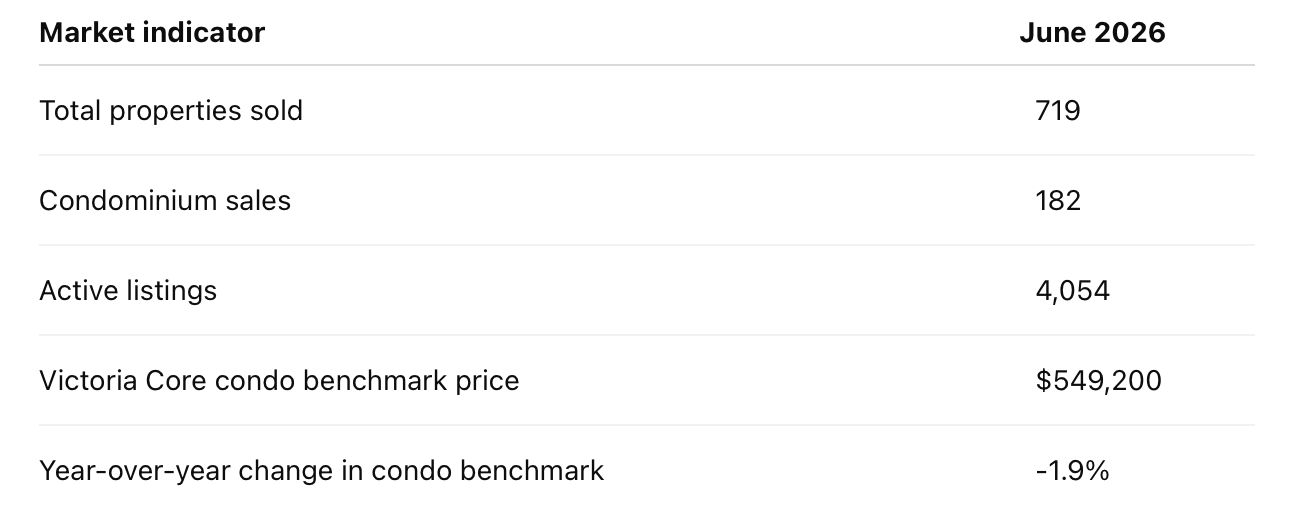
These figures suggest a comparatively balanced market in which buyers may have more time to compare properties and complete appropriate due diligence. They do not mean every condo is negotiable or that every neighbourhood and price range is behaving the same way.
A benchmark price is also not a valuation of a specific property. Building age, location, floor level, view, parking, outdoor space, condition, strata finances and recent comparable sales can materially affect an individual condo’s value.
For continuing local analysis, visit my Victoria real estate market updates and my guide to whether Victoria is a buyer’s market in 2026.
Why Buy a Condo in Victoria?
A condo can be an excellent fit for buyers seeking:- A lower purchase price than many detached homes
- Less exterior maintenance
- A walkable urban lifestyle
- Shared amenities
- A secure lock-and-leave home
- A first step into homeownership
- A downsizing or retirement option
- A long-term rental property, where the numbers and bylaws make sense
The right question is therefore not simply, “Can I afford this condo?” It is also, “Can I afford this building’s present and future obligations?”
What Does Strata Ownership Mean in British Columbia?
When you purchase a strata condo, you generally acquire:- Your individual strata lot
- A proportionate interest in common property and common assets
- Voting rights in the strata corporation
- An obligation to pay strata fees and approved special levies
- A responsibility to comply with the strata’s bylaws and rules
For additional background, read Strata Laws in BC: What Every Buyer Should Know.
Where Should You Buy a Condo in Greater Victoria?
The best location depends on your budget, commute, preferred building style and lifestyle.Downtown Victoria and Harris Green
These areas offer a highly walkable lifestyle close to restaurants, shopping, entertainment and employment. Buyers will find newer high-rises, established concrete buildings, lofts and mixed-use developments.Investigate parking rights, short-term rental rules, commercial components, noise, elevator capacity and the cost of operating amenities.James Bay
James Bay appeals to buyers who want proximity to the Inner Harbour, Beacon Hill Park and the waterfront. Its condo inventory ranges from older low-rise buildings to luxury developments.In an older building, pay particular attention to plumbing, windows, balconies, building-envelope work and upcoming capital projects.
Vic West and Songhees
These neighbourhoods offer harbour access, trails and quick connections to downtown. The area includes both established waterfront buildings and newer developments.Waterfront exposure, parkade maintenance, window systems, balconies and building-envelope history deserve careful review.
Fairfield and Oak Bay
These areas are known for established residential streets, village amenities and access to the ocean. Condo inventory is more limited and often found in smaller or older buildings.A smaller strata may offer a quieter ownership experience but can have fewer owners among whom to divide major repair costs.
Saanich, Uptown and Royal Oak
Saanich offers a broad range of condo styles with convenient access to shopping, transit, the University of Victoria and major transportation routes.Confirm the property’s municipality, transit connections and proximity to the services that matter to you.
Langford, Colwood and View Royal
The West Shore often offers newer buildings and more space for the purchase price. Buyers should consider commute patterns, planned development, construction activity and future neighbourhood growth.Sidney and the Saanich Peninsula
These communities appeal to retirees, downsizers and buyers seeking a quieter coastal lifestyle. Review transportation needs, walkability and whether the unit and building will accommodate future accessibility requirements.Explore my Greater Victoria neighbourhood guides and 2026 guide to the best Victoria neighbourhoods before narrowing your search.
Get Mortgage Pre-Approval Before Shopping
A mortgage pre-approval helps establish an initial budget, but the lender must also approve the specific condo.A lender or mortgage insurer may consider:
- The strata corporation’s financial condition
- Current or anticipated special levies
- Insurance availability and deductibles
- Commercial use within the building
- Litigation involving the strata
- Building condition or known defects
- The amount of the monthly strata fee
- The remaining term of a leasehold interest, where applicable
- Whether the property is suitable for the intended occupancy or rental use
Learn more about mortgage qualification and pre-approval.
How Much Does It Cost to Buy a Condo in Victoria?
Your purchase budget should include more than the down payment and mortgage payment.Potential costs include:
- Property Transfer Tax
- GST on qualifying new construction
- Legal or notary fees
- Title insurance and registration expenses
- Home inspection costs
- Mortgage appraisal fees
- Mortgage default insurance, when applicable
- Condo owner’s insurance
- Property-tax and strata-fee adjustments
- Moving expenses
- Immediate repairs or improvements
- Parking, storage or move-in fees
- A financial reserve for future strata costs
BC Property Transfer Tax
Unless an exemption applies, B.C. Property Transfer Tax is generally calculated as:- 1% on the first $200,000
- 2% on the portion above $200,000 and up to $2 million
- 3% on the portion above $2 million
- A further 2% on the residential portion above $3 million
First-Time Home Buyers’ Property Transfer Tax Exemption
For qualifying first-time buyers, the current exemption operates differently across several price ranges:- Up to $500,000: a full exemption may be available.
- Above $500,000 and up to $835,000: the exemption is limited to $8,000.
- Above $835,000 and below $860,000: the exemption is gradually reduced.
- At $860,000 or more: the exemption is unavailable.
First-time buyers can also visit my Victoria first-time home buyer resources.
Newly Built Home Property Transfer Tax Exemption
A qualifying newly built principal residence may receive a full Property Transfer Tax exemption at a fair market value of $1.1 million or less. A partial exemption may be available above $1.1 million and below $1.15 million.Confirm the property and buyer requirements through B.C.’s newly built home exemption information.
GST on New Condos
GST generally applies to newly constructed or substantially renovated homes, while most conventional resale residential condos are GST-exempt.Qualifying first-time buyers of new homes may now be eligible for the federal First-Time Home Buyers’ GST/HST Rebate. The rebate can eliminate GST on a qualifying new home priced up to $1 million and is gradually reduced between $1 million and $1.5 million. Agreement dates, construction dates, occupancy and other eligibility conditions apply.Do not assume that GST is included in a developer’s advertised price. The purchase contract should clearly state whether GST is included, payable in addition to the price or assigned through a rebate.
What Do Strata Fees Cover?
Monthly strata fees commonly contribute toward:- Building insurance
- Common-area utilities
- Cleaning and landscaping
- Property management
- Elevator and mechanical maintenance
- Garbage and recycling
- Caretaking
- Amenities
- Contributions to the contingency reserve fund
A low strata fee is not automatically a positive sign. It may reflect a simple, efficiently managed building, but it may also indicate inadequate reserve contributions, deferred maintenance or an artificially low operating budget.
Similarly, a higher fee is not automatically evidence of poor management. It may include heat, water, extensive amenities, full-time staff or responsible contributions toward future work.
Read What Are Strata Fees? for a more detailed explanation.
The Form B Information Certificate
A current Form B Information Certificate is one of the most important documents in a B.C. strata purchase.Depending on the property and circumstances, it can disclose:
- The unit’s monthly strata fee
- Money the current owner owes the strata
- Agreements relating to alterations
- Approved special levies and unpaid instalments
- Anticipated budget overruns
- The contingency reserve fund balance
- Certain litigation or arbitration
- Parking and storage information
A Form B is only a snapshot. Important events can occur after it is issued, including an annual general meeting, a new insurance claim, litigation or approval of a special levy. Whenever possible, obtain a current certificate and review developments occurring after its date.See the province’s Form B Information Certificate guidance.
Essential Strata Documents to Review
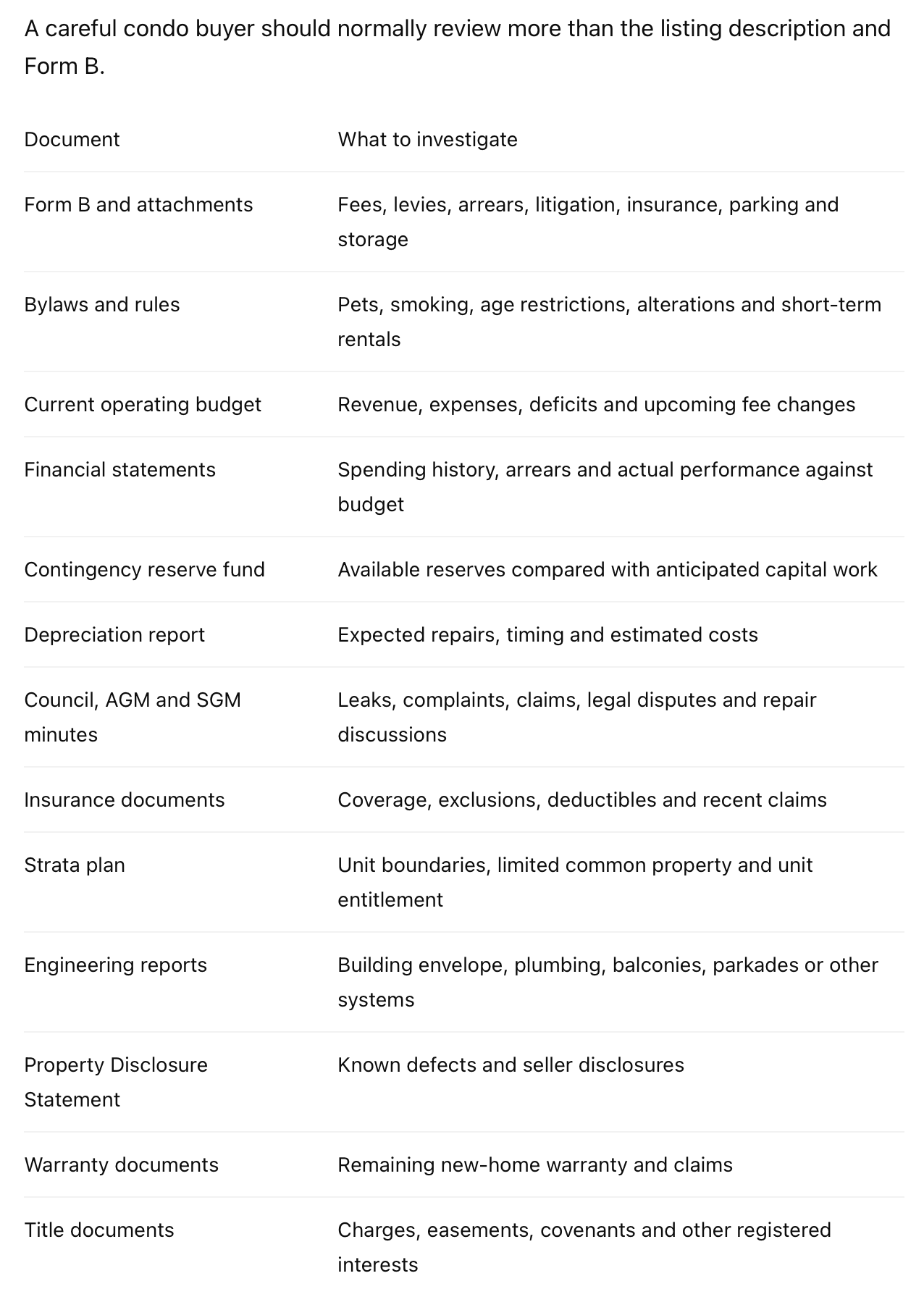
Two years of strata council, annual general meeting and special general meeting minutes are commonly requested. Older records may also be important when a significant project or recurring problem predates that period.
A real estate professional can organize and identify concerns in these records, but legal, accounting, engineering or insurance questions should be referred to an appropriately qualified professional.
Depreciation Reports: An Important 2026 Change
A depreciation report is a long-term planning document that identifies major common assets and estimates when they may require repair or replacement over a 30-year period.It can include:- Roofs and exterior walls
- Windows and doors
- Plumbing and electrical systems
- Elevators
- Balconies
- Parkades
- Roads and landscaping
- Boilers and mechanical systems
For many strata corporations in the Capital Regional District that did not have a qualifying recent report, the deadline to obtain one was July 1, 2026. Specific timing rules and exceptions can apply, including rules for newer stratas.Read the province’s current depreciation-report requirements.
A depreciation report is not a guarantee that work will cost exactly what is estimated. Compare it with the strata’s current reserves, annual contributions, approved projects and actual repair decisions.
My guide to strata financials, depreciation reports and contingency funds explains how these pieces fit together.
The Contingency Reserve Fund
The contingency reserve fund, or CRF, is intended for expenses that occur less frequently than once a year or that do not usually appear in the operating budget.Since November 1, 2023, the minimum annual CRF contribution is generally 10% of the amount budgeted for the annual operating fund. This is a minimum contribution, not a statement that the resulting reserve balance is adequate.A healthy-looking balance can become insufficient when compared with a major roof, parkade or building-envelope project. Conversely, a modest balance may be reasonable in a newer building with fewer near-term projects, although future obligations still require planning.
Evaluate the CRF in relation to:
- The depreciation report
- The age and condition of major systems
- Approved or discussed repairs
- Historical reserve contributions
- Upcoming warranty expirations
- The number of owners sharing future costs
Special Levies: Who Pays?
A special levy is an additional amount approved by the owners for a specific purpose, often a major repair or unexpected expense.Under B.C.’s general rules, if a levy is approved before ownership transfers:
- The seller is responsible for instalments due before the transfer date.
- The buyer is responsible for instalments due on or after the transfer date.
This is why meeting minutes matter. A future levy may not yet appear on the Form B if it has not been formally approved.
Review the province’s special levy guidance and ensure the contract clearly addresses known levies.
Review the Bylaws Before You Buy
Strata bylaws can significantly affect how you use your home.Review restrictions concerning:
- Pets, including number, size or breed
- Smoking and vaping
- Barbecues
- Flooring and renovations
- Window coverings
- Age restrictions
- Short-term accommodation
- Home-based businesses
- Noise and quiet hours
- Move-in procedures
- EV charging
- Bicycle storage
Provincial short-term rental legislation, municipal zoning and licensing requirements can also apply. A property advertised as an “investment condo” is not automatically suitable for vacation rental use.
Review the province’s strata legislation changes and short-term rental requirements before relying on anticipated rental income.
Strata Insurance and Your Condo Owner’s Policy
The strata corporation must insure common property, common assets, buildings shown on the strata plan and certain original fixtures. Its policy generally does not replace your own condo insurance.Your personal policy may need to address:
- Personal belongings
- Personal liability
- Unit improvements and betterments
- Additional living expenses
- Loss assessments
- Strata deductible exposure
- Coverage required by your lender
Learn more from the province’s strata corporation insurance guidance.
Parking, Storage and EV Charging
A parking stall or storage locker may be:- Part of the strata lot
- Designated limited common property
- Common property assigned by the strata
- Subject to a lease, licence or other agreement
- The correct stall and locker numbers
- How each space is legally designated
- Whether the right transfers to the buyer
- Vehicle height or size restrictions
- Guest-parking rules
- Bike-storage availability
- EV-charging rules and electrical capacity
Electrical Planning Reports
Strata corporations with five or more lots in most of the Capital Regional District must obtain an electrical planning report by December 31, 2026.The report evaluates current electrical capacity, existing demand, spare capacity and anticipated future demand from technologies such as EV chargers and heat pumps. It also provides recommendations for future electrical planning.If EV charging is important to you, do not rely only on the presence of a nearby electrical outlet. Review the building’s bylaws, existing charging infrastructure, electrical planning and approval process.
See B.C.’s electrical planning report requirements.
Should You Get a Condo Inspection?
Yes. A condo inspection can identify concerns within the unit and visible parts of the property, including:- Plumbing leaks
- Moisture damage
- Electrical concerns
- Heating and cooling equipment
- Appliances
- Windows and doors
- Ventilation
- Interior alterations
- Signs of past repairs
If documents identify a building-envelope, structural, plumbing or parkade concern, an appropriate specialist may be needed.
Read my home inspection guide for Victoria buyers.
Buying in an Older Condo Building
An older building can offer larger floor plans, established neighbourhoods and good value. Age alone should not eliminate a property from consideration.The central question is how the building has been maintained and financially managed.Investigate:- Building-envelope and water-ingress history
- Roof replacement
- Window and sliding-door replacement
- Domestic plumbing
- Drainage
- Balconies
- Elevators
- Boilers and mechanical systems
- Parkade membranes
- Electrical capacity
- Asbestos or other hazardous materials
- Completed seismic work
- Past insurance claims
- Deferred projects
Buying a New or Pre-Sale Condo
New construction involves different risks and documents from a conventional resale purchase.Review:- The developer’s disclosure statement and amendments
- Estimated completion dates
- Deposit schedule
- Assignment provisions
- Estimated strata fees
- Proposed bylaws
- Parking and storage rights
- Proposed amenities
- Adjustment charges
- GST treatment
- Financing risks if completion is delayed
- The developer’s experience and track record
Review the BCFSA pre-sale buyer guide, my Victoria pre-sale condo guide and my article on developer red flags in newly created stratas.
Most new homes built by licensed residential builders must carry 2-5-10 home warranty insurance. Minimum coverage generally includes two years for specified labour and material defects, five years for the building envelope and ten years for structural defects. Coverage details and commencement dates vary, so review the actual policy.
Learn more in my 2-5-10 home warranty guide and the official BC Housing warranty information.
You can also explore Victoria new-construction homes.
Protecting Your Offer
Depending on the property and circumstances, a condo offer may include conditions relating to:- Financing
- Home inspection
- Strata-document review
- Property Disclosure Statement
- Title review
- Insurance
- Legal advice
- Sale of another property
B.C.’s Home Buyer Rescission Period generally gives buyers three business days after an accepted offer to rescind many residential purchase contracts. The right cannot be waived, and exercising it normally requires paying the seller 0.25% of the agreed purchase price. Statutory exceptions apply.
The rescission period is not a substitute for financing, inspection, insurance or document-review conditions.
Consult the BCFSA Home Buyer Rescission Period guide, my rescission-period FAQ and my guide to making an offer on a Victoria property.
Condo Buyer Red Flags
No single warning sign automatically makes a condo a poor purchase. Multiple unresolved concerns, however, require closer investigation.Watch for:
- No current depreciation report when one should be available
- Repeated water leaks or building-envelope complaints
- A small reserve fund combined with substantial upcoming work
- Recurring operating deficits
- Strata fees that appear artificially low
- Major projects discussed but not yet approved
- Frequent insurance claims or very high deductibles
- Ongoing litigation
- Persistent owner arrears
- Repeated conflict at council or general meetings
- Unapproved alterations to the unit
- Unclear parking or storage rights
- Significant work being postponed year after year
- Important reports referenced in minutes but not provided
- A lender or insurer unwilling to accept the building
Step-by-Step: How to Buy a Condo in Victoria
A well-organized purchase process normally includes:- Establish your budget and obtain mortgage pre-approval.
- Define your preferred neighbourhoods, building types and essential features.
- Review suitable Victoria condos for sale.
- Evaluate comparable sales and current market conditions.
- Prepare an offer with appropriate terms and conditions.
- Obtain and review current strata documents.
- Complete the home inspection.
- Confirm financing and insurance for the specific property.
- Obtain legal, tax or technical advice where necessary.
- Remove conditions only when satisfied.
- Complete conveyancing with your lawyer or notary.
- Conduct a final walkthrough and prepare for possession.
Frequently Asked Questions About Buying a Condo in Victoria
Is buying a condo in Victoria a good investment?
It can be, but the answer depends on purchase price, location, building condition, strata finances, ownership costs, rental rules and your intended holding period. No property should be purchased solely on an assumption of future appreciation.How much are strata fees in Victoria?
There is no reliable citywide fee that applies to every condo. Fees vary according to unit entitlement, building size, age, amenities, utilities, staffing, maintenance needs and reserve contributions. Compare what is included and whether the budget is adequate—not only the monthly dollar amount.Can a strata ban long-term rentals in BC?
A strata corporation can no longer prohibit or limit long-term residential rentals through a rental-restriction bylaw. Short-term rental bylaws, 55-plus age bylaws and other lawful use restrictions can still affect a property.Who pays a special levy when a condo is sold?
Unless the purchase contract reallocates the cost, the seller generally pays levy instalments due before ownership transfers, while the buyer pays instalments due on or after the transfer date.Does every strata need a depreciation report?
B.C. strata corporations with five or more strata lots generally require a depreciation report on a five-year cycle. Timing requirements and limited exceptions can apply, particularly for newer stratas.Should I inspect a condo before buying?
Yes. An inspection can identify issues inside the unit and visible concerns elsewhere. It should be combined with a review of strata documents and, where appropriate, engineering or other specialist advice.Are older condos in Victoria risky?
Not necessarily. A well-maintained older building with responsible financial planning may be preferable to a newer building with unresolved construction or governance problems. Maintenance history and future obligations matter more than age alone.Can a Victoria strata prohibit pets?
Yes. A strata can restrict or prohibit pets through its bylaws, subject to applicable human-rights and other legal requirements. Always review the registered bylaws rather than relying on listing remarks.Find the Right Victoria Condo
The right condo is more than an attractive suite. It should fit your budget, lifestyle and long-term plans while belonging to a strata corporation whose condition, rules and finances you understand.I help Victoria condo buyers:- Identify suitable neighbourhoods and buildings
- Evaluate recent comparable sales
- Structure competitive, protective offers
- Obtain and organize strata documents
- Identify financial and maintenance concerns
- Coordinate inspections, financing and insurance
- Navigate the transaction through completion
Disclaimer
This article provides general information about buying a strata property in Victoria, British Columbia. It is not legal, financial, mortgage, tax, accounting, insurance, engineering or home-inspection advice.Real estate laws, tax programs, lending requirements, strata obligations and market conditions can change. Information was reviewed as of July 31, 2026, but may not apply to every buyer, property or transaction.
Buyers should independently verify all material information and obtain advice from qualified professionals, including a B.C. lawyer or notary, mortgage professional, accountant, insurance provider, licensed home inspector and engineer or other specialist where appropriate.
Strata documents, estimates, depreciation reports and market statistics do not guarantee future costs, property condition, resale value, rental income or market performance. Janine Thomson and Pemberton Holmes make no representation that every concern affecting a particular property can be identified through a standard document review or showing.
