

By Janine Thomson, REALTOR® | Pemberton Holmes
Victoria and Vancouver Island Real Estate
 If you have been waiting for a Victoria, BC buyer’s market in 2026, the answer is more nuanced than a simple yes or no.Greater Victoria has substantially more homes for sale than buyers saw during the intense, low-inventory years. Many purchasers now have more time to compare properties, include protective conditions and negotiate terms. However, desirable homes that are well priced can still attract immediate attention and occasionally multiple offers.
The most recent Victoria Real Estate Board market report described the region as active and balanced. In June 2026, 719 properties sold across the VREB region while 4,054 active listings remained at month-end. Inventory was 7.3% higher than in June 2025, while sales were 5.5% lower year over year.
That combination gives many buyers more choice and negotiating room, but it does not make every neighbourhood, price range or property type a buyer’s market. Real estate conditions are local even from one street, building or price bracket to the next.
So, is now a good time to buy in Victoria, BC? It may be, particularly if you are financially prepared, plan to own for several years and know how to identify listings where the seller’s expectations and the current market are out of alignment.
This guide explains the Victoria real estate market in 2026, where buyers may find opportunities, what can be negotiated besides price and how to build a practical strategy for the next 90 days.Want to see where the opportunities are right now?
Ask me for a list of Victoria properties with recent price reductions, longer market exposure or motivated sellers.
Victoria Real Estate Market 2026: The Latest Numbers
Here is the latest Greater Victoria market snapshot available at the time of this update: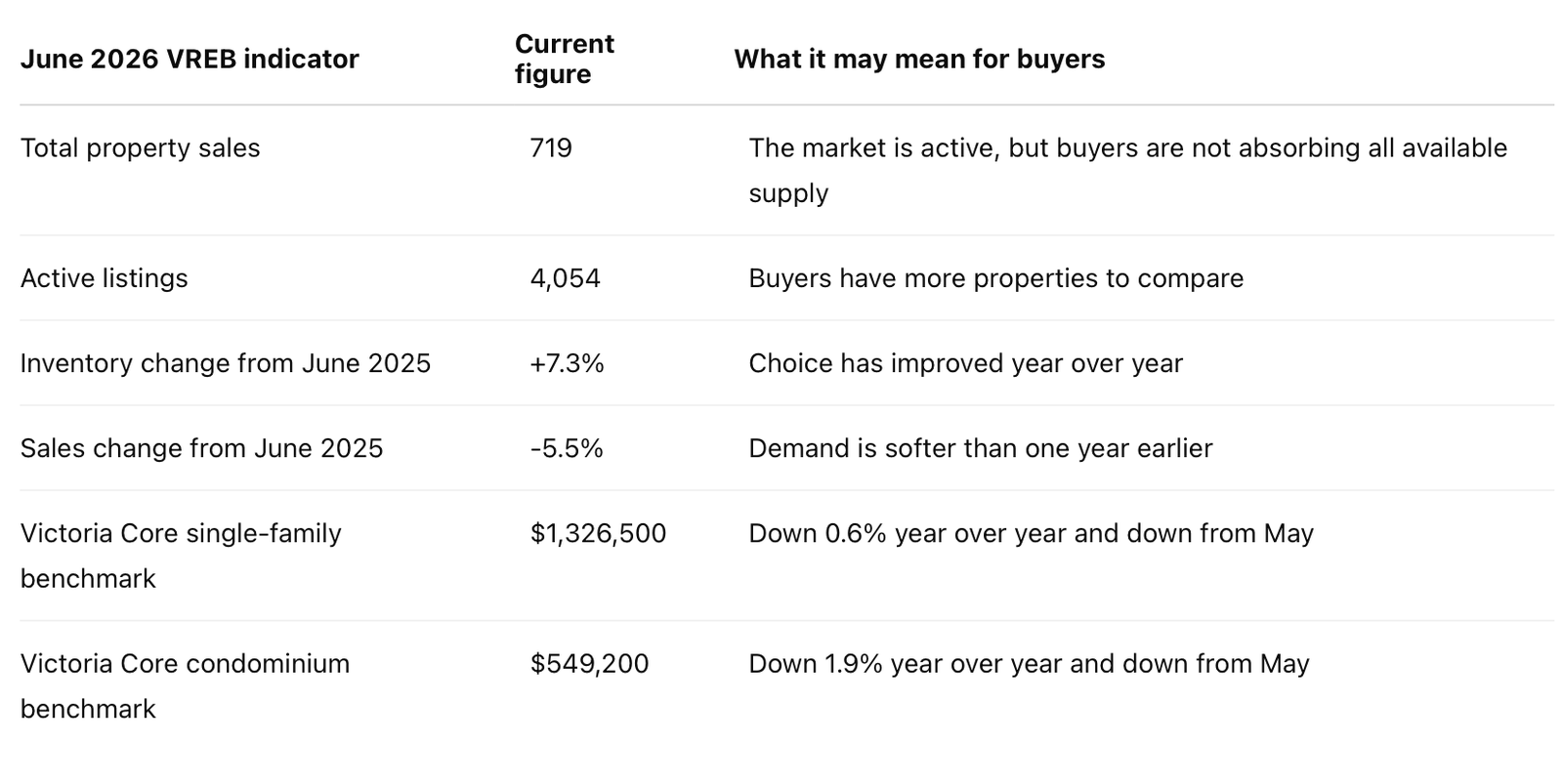
VREB reported 388 single-family-home sales in June, down 3.5% from June 2025. Condominium sales totalled 182, down 26.9% year over year. The larger decline in condo sales is an important signal for buyers, although it should never be applied automatically to every building or unit.
These figures suggest a market with better buyer conditions than the pandemic-era market, not a market in which every seller must accept a substantial discount. Benchmark prices are also broad measures. They cannot determine the value of a particular home, because condition, location, lot, floor plan, renovations, strata health and recent comparable sales all matter.
If you are beginning your search, start with my complete guide to buying a home in Greater Victoria and mortgage pre-approval guide. Knowing your comfortable budget and financing conditions gives you the confidence to negotiate without overreaching.
What Defines a Buyer’s Market?
A buyer’s market generally exists when the supply of homes meaningfully exceeds current buyer demand. Listings accumulate, properties take longer to sell and sellers compete more actively for qualified purchasers. Buyers may have greater success negotiating price, dates, conditions, repairs or other terms.A seller’s market is the reverse: there are too few properties relative to demand. Well-priced homes sell quickly, competing offers become common and purchasers often have less influence over price and terms.
A balanced market sits between the two. Neither side has a consistent, overwhelming advantage.
One common measurement is the sales-to-active-listings ratio: the number of sales during a period compared with the number of active listings. As a rough illustration, June’s 719 sales represented approximately 17.7% of the 4,054 listings active at month-end. That calculation is only a simplified market-level indicator, monthly sales and month-end inventory are not identical datasets, but it supports VREB’s description of a broadly balanced market.
The key phrase is broadly balanced. A $550,000 condo in one building may face different competition from a renovated family home near a sought-after school or a waterfront property with few true comparables.
Current Greater Victoria Inventory: More Choice Changes the Conversation
The 4,054 active listings recorded at the end of June gave buyers more selection than they had a year earlier. Greater choice can change both the pace and the tone of a purchase.Instead of feeling forced to pursue the only suitable listing, a buyer may be able to compare:
- several buildings with similar amenities;
- renovated and unrenovated homes in the same area;
- a larger home farther from the urban core with a smaller property closer in;
- monthly strata costs against purchase-price savings;
- a new listing against one that has already been exposed to the market for several weeks.
However, inventory is not evenly distributed. Some buyers still have a narrow search because they need a specific school catchment, accessible floor plan, suite configuration, transit connection, pet policy or possession date. Your effective inventory is not every listing in Greater Victoria, it is the number of properties that truly meet your needs and budget.
You can search current Victoria-area MLS® listings or explore my Greater Victoria neighbourhood guide before narrowing your target areas.
Sales Compared With Available Listings
June’s 719 sales show that people are still buying. This is not a frozen market. Yet, with more than 4,000 active listings remaining at month-end, buyers were not exhausting the available supply.That gap produces opportunity, especially where listings compete directly with one another. Imagine five similar two-bedroom condos for sale in the same neighbourhood. If one is vacant, one has already reduced its price and another has dated finishes, each seller may have a different level of urgency. The value of careful comparison rises as the number of alternatives increases.
Sales numbers should also be read seasonally. Spring and early summer are typically active periods. A property that failed to sell through the busiest part of the season may deserve closer analysis, but longer exposure is not proof of a distressed seller. The listing could be overpriced, poorly presented, tenanted, difficult to show or affected by a property-specific issue.
Average Days on Market: Useful, but Never the Whole Story
Days on market tells you how long a listing has been exposed to buyers. It is a valuable negotiating clue, but it must be interpreted correctly.An average can hide two very different markets: attractive, accurately priced homes that sell in days and ambitious listings that remain available for months. It can also reset when a property is cancelled and relisted. That is why I look beyond the number displayed on the current listing.
For each property, buyers should review:
- the original list date;
- previous MLS® listing history;
- cancellations and relistings;
- cumulative market exposure;
- prior asking prices;
- conditionally sold periods that collapsed;
- comparable homes that sold while the property remained available.
The important question is not merely, “How many days has it been listed?” It is, “What has the market already told this seller?”
Price Reductions and Expired Listings
Price reductions are among the clearest signs that a seller is responding to market feedback. A reduction may indicate that:- showings have been limited;
- buyers viewed the home but did not write;
- competing properties offered better value;
- the seller’s timeline has become more important;
- the original price was designed to test the market.
The better approach is to compare the revised price with recent sales, current competition and the property’s condition. If the new price is supported, waiting for another reduction could cost you the home.
Condos, Townhomes and Houses Do Not Behave the Same Way
Condominiums
Condo buyers may find stronger negotiating conditions in buildings with several similar units for sale. June condo sales were down substantially year over year, which may give buyers more room in some segments.Yet strata risk matters as much as price. Review depreciation reports, meeting minutes, budgets, insurance, contingency reserves, bylaws, engineering reports and planned projects. A low purchase price can become expensive if the building has an unfunded roof, envelope, plumbing, elevator or parkade project.Read my detailed guide to buying a condo in Victoria and Victoria home-inspection guide before removing conditions.
Townhomes
Townhomes often attract buyers who need more space than a condo but cannot, or do not want to, purchase a detached house. Well-located, family-friendly townhomes can still move quickly because supply is limited in some areas.Negotiating power can improve when a complex has multiple competing units, the home needs cosmetic work or the strata has restrictions that narrow its audience. Compare not only price per square foot but also yard space, parking, storage, strata fees and future capital work. My Victoria versus Langford townhome comparison offers useful context.
Detached houses
Detached-home conditions vary dramatically. A renovated home in a high-demand neighbourhood may receive fast offers even in a balanced regional market. A dated house with oil-tank risk, drainage concerns, an unverified suite or significant deferred maintenance may sit longer.Detached-home buyers should consider the total cost of ownership, not just the negotiated discount. A $50,000 price reduction can disappear quickly if the home needs a roof, perimeter drains, sewer work, electrical upgrades and major energy improvements.
Neighbourhoods Where Buyers May Find More Choice
Buyer choice often improves where new construction, broader housing variety or greater geographic supply creates competition. Depending on your budget and property type, opportunities may appear in Langford, Colwood, Sooke, Esquimalt, View Royal and parts of Saanich, as well as selected condo-heavy areas in Victoria.That does not mean every property in these communities is negotiable. West Shore homes near schools, recreation and commuter routes can attract strong demand. Entry-level properties in Sooke may draw several budget-conscious buyers. A rare unit in a well-run downtown or James Bay building may still command attention.
Start with lifestyle and practical needs, then look for leverage within the right location. My Best Neighbourhoods in Victoria, BC: 2026 Buyer Guide can help you compare communities by housing type, commute and day-to-day fit.
Properties That May Offer Negotiating Opportunities
Certain listing patterns deserve closer attention:- properties with several price reductions;
- homes with long cumulative market exposure;
- vacant homes where the owner is carrying costs;
- estate sales, subject to the legal authority and seller’s circumstances;
- tenanted properties with showing or possession complications;
- homes that need cosmetic work;
- listings that returned after a collapsed offer;
- properties competing with several near-identical listings;
- new-construction inventory where a developer has completed units available;
- listings approaching an important seller timeline.
For example, one seller may value an earlier completion. Another may need a later possession date. A vacant-property seller may favour certainty and a short condition period. A family may care more about time to move than the last few thousand dollars.This is why negotiation is about terms, not just price.
How to Identify an Overpriced Listing
An overpriced home is not simply one you cannot afford. It is a property whose asking price is not adequately supported by recent comparable sales, current competition, condition and location.Potential warning signs include:
- similar homes sold for less;
- better competing listings are available at the same price;
- the seller priced renovations dollar-for-dollar without considering market value;
- the asking price is based on an old peak rather than current evidence;
- repeated showings have not produced an offer;
- the home has remained available while nearby listings sold;
- the price crosses into competition with a superior property category.
If a property appears overpriced, your offer should still be evidence-based. A well-supported offer gives the seller a rational reason to reconsider. An arbitrary low number can shut down the conversation.
What Victoria Buyers Can Negotiate Besides Price
Completion and possession dates
Dates can be extremely valuable. You may be able to negotiate a completion date that aligns with your rate hold or lease, or a possession date that reduces temporary housing and moving costs.Included furnishings and chattels
Patio furniture, shelving, a freezer, window coverings or other items may be included if both parties agree and the contract describes them clearly. Do not assume everything seen during a showing remains.Repairs or a financial credit
An inspection may uncover a material defect. Depending on the contract and circumstances, the parties might negotiate a repair, price adjustment or credit. The seller is not automatically required to fix inspection findings, and any change should be documented properly.Subject periods
The length and wording of financing, inspection, document-review and other conditions can be negotiated. A shorter subject period may appeal to a seller, but it must give your lender, inspector, lawyer and other professionals enough time.Strata assessments
If a special levy has been approved or is expected, the contract should clearly address who is responsible. The answer may depend on timing, contract wording and professional legal advice. Never rely on a verbal understanding.Professional cleaning
A buyer may request professional cleaning or specify the expected condition on possession. Clear wording matters because “clean” can be subjective.Oil-tank scans and sewer inspections
For older Victoria-area homes, buyers may seek time and access for an oil-tank scan, sewer scope or additional drainage review. These investigations can be more valuable than a small price concession because they reduce uncertainty about potentially significant costs.Other due-diligence access
Depending on the property, negotiations may address septic inspection, well testing, insurance confirmation, suite documentation, electrical review, engineering advice or contractor estimates.For a broader explanation of conditions and contract strategy, review my Victoria buyer resources and home inspection information.
When Is a Low Offer Appropriate?
A low offer may be reasonable when market evidence supports it. Examples include a significantly overpriced listing, major required repairs, extended exposure, repeated failed attempts to sell or a sharp gap between the asking price and comparable sales.A strategically low offer should include:
- recent and relevant comparable sales;
- realistic estimates for material deficiencies;
- clear, workable terms;
- a deposit and timeline that demonstrate seriousness;
- enough room to negotiate without becoming insulting or losing credibility.
There is also a difference between a low offer and a weak offer. A lower price paired with clean dates, organized financing and carefully chosen conditions can be more appealing than a higher offer with uncertain terms.
When Buyers Still Need to Act Quickly
More inventory does not mean there is no urgency. Buyers should be ready to move when a listing is:- newly listed at a compelling price;
- renovated and move-in ready;
- rare for its neighbourhood or building;
- in a highly requested school catchment;
- suitable for a large buyer pool;
- offering a legal or highly functional secondary suite;
- unique in view, lot, accessibility or location;
- already attracting strong showing activity.
My buyer closing-cost guide explains Property Transfer Tax, legal fees, inspections, insurance, adjustments and other expenses that belong in your budget.
Risks of Waiting for the “Perfect” Market
Trying to buy at the exact bottom sounds sensible, but market bottoms are usually clear only in hindsight.Waiting has several risks:- the right property may not be available later;
- mortgage rates or lending rules may change;
- your rent and moving costs may continue;
- competition may return before headlines confirm the shift;
- prices may stabilize while your preferred segment remains competitive;
- personal needs may become more urgent.
For a helpful overview of common pitfalls, read 10 Things to Avoid When Buying a Home in Victoria, BC.
A Practical Victoria Home-Buying Strategy for the Next 90 Days
Days 1–15: Prepare
- Obtain or update a full mortgage pre-approval.
- Confirm your maximum purchase price and comfortable monthly payment.
- Reserve cash for closing costs, repairs and an emergency fund.
- Choose the two or three property types and areas that best fit your needs.
- Identify non-negotiables and preferences.
- Engage a buyer’s REALTOR® who can review listing history and comparable sales.
Days 16–30: Learn the market
- Set up a personalized MLS® search.
- Tour a representative sample of homes, not only your favourites.
- Track list price, reductions, days on market and final sale price.
- Compare strata fees, expected repairs and transportation costs.
- Read sample strata documents so you know what deserves attention.
Days 31–60: Target opportunities
- Review price-reduced and longer-exposure listings each week.
- Revisit properties that were close but initially overpriced.
- Watch for collapsed sales and relisted homes.
- Ask which terms matter to each seller.
- Prepare a property-specific due-diligence plan before offering.
Days 61–90: Negotiate decisively
- Write evidence-based offers on homes that meet your needs.
- Use comparable sales rather than broad headlines to support price.
- Protect yourself with appropriate conditions.
- Negotiate dates and other terms that create value for both sides.
- Walk away when the numbers or risks do not work.
- Act promptly when a genuinely strong listing is correctly priced.
Learn what it is like to work with me as your Victoria buyer’s agent, including pre-approval, personalized MLS® searches, showings, offer strategy and due diligence.
Frequently Asked Questions About the Victoria BC Buyer’s Market in 2026
Is Victoria, BC officially a buyer’s market in 2026?
The latest VREB commentary describes Greater Victoria as active and balanced. Buyers have more choice and often more negotiating room than during the severe low-inventory years, but conditions differ by property type, price and neighbourhood.Is now a good time to buy in Victoria, BC?
It can be a good time for a prepared buyer with stable finances and a suitable long-term plan. Higher inventory and softer year-over-year sales provide opportunities, but the right decision depends on your budget, mortgage, time horizon and the specific property.Are Victoria home prices falling in 2026?
In June 2026, the Victoria Core benchmark was $1,326,500 for a single-family home, down 0.6% from June 2025. The condo benchmark was $549,200, down 1.9% year over year. These are benchmark trends, not valuations for individual properties.How much below asking price should I offer?
There is no universal percentage. The right offer depends on comparable sales, competing listings, condition, cumulative market exposure, seller motivation and your own walk-away price. Some homes are overpriced; others are priced accurately and may sell near or above asking.Can I ask a seller to pay a strata special assessment?
Responsibility for a levy should be addressed clearly in the contract, with appropriate professional advice. Timing and the wording of the resolution and contract matter. Your REALTOR® and lawyer or notary can help you understand the issue.Should I include a home-inspection condition in 2026?
In most cases, an inspection condition remains a prudent protection. Condo and townhome buyers should also review strata documents carefully. Learn more in my Home Inspection Explained guide.Are condos more negotiable than houses in Victoria?
Condo sales were notably lower year over year in June, and buildings with multiple competing units may provide leverage. However, a desirable unit in a strong building can still sell quickly. Compare the specific unit, building and competition.How can I find motivated sellers in Greater Victoria?
Look for cumulative days on market, price changes, failed sales, vacancy, competing inventory and seller timing. MLS® history and direct communication through the listing agent can reveal context that a public listing page may not show.The Bottom Line: Buyers Have Leverage, but It Must Be Used Well
The Victoria, BC buyer’s market in 2026 is best described as a collection of opportunities within a broadly balanced regional market.Buyers benefit from increased inventory, softer year-over-year sales and modest benchmark-price declines in the Victoria Core. In some listings, you may negotiate price, completion and possession dates, repairs, credits, included items, condition periods, cleaning, strata assessments or access for specialized inspections.
But the best homes are still selling. A successful buyer does not assume every seller is desperate or wait indefinitely for a perfect market. The strongest approach is to prepare early, study the correct comparables, investigate the property thoroughly and make a credible offer when the right opportunity appears.Ask me for a list of Victoria properties with recent price reductions, longer market exposure or motivated sellers.
Janine Thomson, REALTOR® · ABR® · SRS®
Pemberton Holmes, Victoria, BC
Phone: 778-678-5466
Email: info@janinethomson.net
Pemberton Holmes, Victoria, BC
Phone: 778-678-5466
Email: info@janinethomson.net
