
By Janine Thomson - Victoria Realtor | Pemberton Holmes
Originally published March 26, 2026 · Updated September 27, 2026
If you’re hoping to buy your first home in Greater Victoria, it’s reasonable to wonder whether homeownership is still within reach. Prices remain high, and the down payment is only one part of the budget. But there are more choices on the market than many buyers expect, and several programs may help you plan a purchase.
The answer depends on what you want to buy, where you’re willing to look, and what the full monthly cost means for your household. Let’s put real numbers around that decision.
What does a first home cost in Victoria?
There is no single “first-home price.” A compact condo, a larger two-bedroom unit, and a townhouse with family-sized space can have very different prices and ongoing costs.For a dated point of reference, the Victoria Real Estate Board reported an August 2026 benchmark value of $553,600 for a condominium in the Victoria Core. Its benchmark for a single-family home in the Victoria Core was $1,301,800.
A benchmark describes a representative property in a defined area; it is not the average sale price or a promise that you’ll find a suitable home at that price.
The Board also reported 3,662 active listings across its region at the end of August. It described conditions as stable and balanced, giving buyers room to compare options. That doesn’t mean every desirable home will sit on the market or that every seller will negotiate, but it does mean you can approach your search with a plan instead of assuming you must rush.
Source: Victoria Real Estate Board, August 2026 market report.
How much down payment do you need?
For an eligible purchase priced below $1.5 million, the minimum down payment is:- 5% of the first $500,000, plus
- 10% of the portion above $500,000.
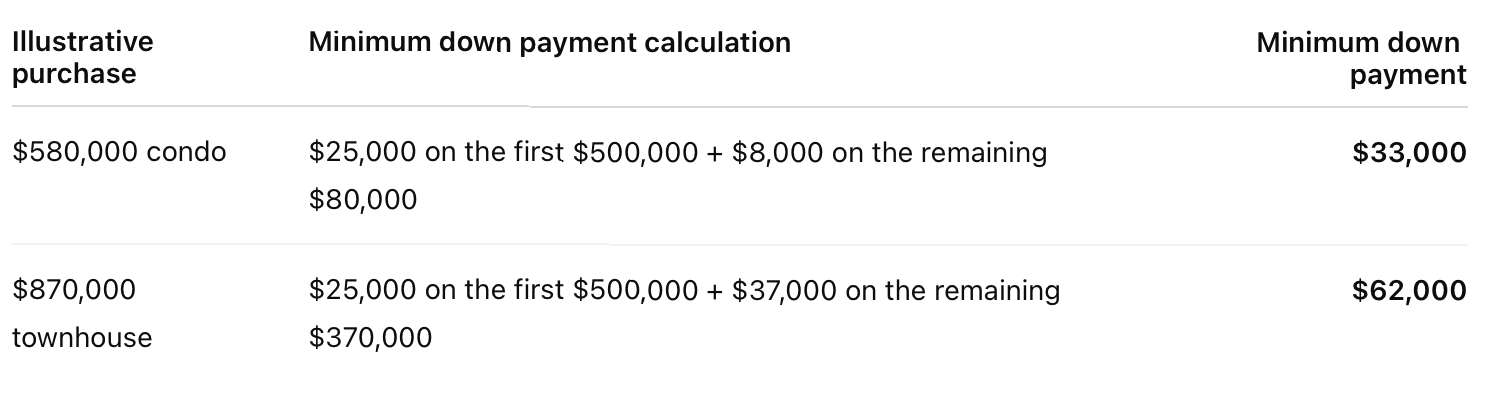
These are minimums, not recommendations for every household. You also need to budget for costs such as a home inspection, legal or notary services, moving, and any applicable property transfer tax or GST.
A deposit written into your offer is generally credited toward the purchase price at completion; it is not an extra down payment on top of the agreed purchase price.
With less than 20% down, mortgage default insurance is generally required. Its premium depends partly on the size of your down payment and is often added to the mortgage. That increases your monthly payment, so leaving it out of a payment example can make a home look more affordable than it is.
Sources: Government of Canada down payment guide and CMHC mortgage insurance costs.
What might the monthly payment look like?
The following examples are illustrations, not current mortgage offers or approvals. Both assume a 5% mortgage interest rate, a 25-year amortization, monthly payments, and a mortgage insurance premium added to the loan.Actual rates, premiums, strata fees, taxes, and lending terms will vary.
Example 1: A $580,000 condo
- Purchase price: $580,000
- Down payment: $40,000
- Base mortgage: $540,000
- Illustrative mortgage insurance premium at 4%: $21,600
- Mortgage including that premium: $561,600
- Approximate monthly mortgage payment at 5% over 25 years: $3,266
- If the monthly strata fee is $400: approximately $3,666 for the mortgage and strata fee
Example 2: An $870,000 townhouse
- Purchase price: $870,000
- Down payment: $90,000
- Base mortgage: $780,000
- Illustrative mortgage insurance premium at 3.1%: $24,180
- Mortgage including that premium: $804,180
- Approximate monthly mortgage payment at 5% over 25 years: $4,677
- If the monthly strata fee is $500: approximately $5,177 for the mortgage and strata fee
Some eligible first-time buyers can choose an insured mortgage amortization of up to 30 years. That can lower the monthly payment, but it generally means paying more interest over the life of the mortgage. Ask a mortgage professional to compare both options using your own numbers.
Sources: CMHC insurance premium schedule and Government of Canada mortgage amortization guide. Payments above are rounded estimates.
What income do you need?
There is no responsible single income figure I can give every first-time buyer. Two households with the same income may qualify for very different mortgages if one has car payments, student loans, or other debt.For an insured mortgage, CMHC generally measures housing costs against gross household income using a gross debt service ratio of up to 39%. That calculation includes the mortgage payment, property taxes, heating, and 50% of applicable condo fees. A separate total debt service ratio of up to 44% considers other debt payments as well. Lenders apply mortgage qualification rules, so approval is not based simply on whether you feel comfortable making the payment shown in an online calculator.
Just as important, qualifying for a mortgage and enjoying life with its payments are different questions. Leave room in your own budget for groceries, transportation, savings, maintenance, and the activities that matter to you.
A mortgage pre-approval can give you a useful price range and may include a temporary rate hold. It does not guarantee final financing: the lender must still review the property and confirm your application.
Sources: CMHC mortgage insurance qualification requirements and Government of Canada pre-approval guide.
Which first-time buyer programs could help?
Programs work in different ways. Some reduce tax, some help you save, and some let you use money already in your RRSP. They are not all cash grants, and each has its own eligibility rules.- B.C. First Time Home Buyers’ Program: An eligible buyer may save up to $8,000 in property transfer tax. The full $8,000 exemption can apply to the first $500,000 of value for qualifying homes up to $835,000, with a reduced exemption above $835,000 and below $860,000.
- First Home Savings Account (FHSA): An eligible person can contribute up to $40,000 over their lifetime, subject to annual contribution-room rules. Contributions are generally deductible, and qualifying withdrawals, including investment growth, are tax-free.
- RRSP Home Buyers’ Plan: An eligible buyer can withdraw up to $60,000 from their RRSP toward a qualifying home. This is their own money and is generally repayable. Eligible first withdrawals made in 2026 benefit from a delayed repayment start; a first withdrawal in 2026 has a first required repayment year of 2031.
- Federal first-time home buyers’ GST/HST rebate: An eligible buyer of a qualifying new home may receive a rebate of up to $50,000. The full rebate can apply to a home valued up to $1 million, with a reduced rebate between $1 million and $1.5 million.
- Other possible tax relief: Depending on the property and your circumstances, the B.C. newly built home property transfer tax exemption and the federal Home Buyers’ Amount may also apply.
Is September 2026 a better time to buy?
Greater Victoria’s August figures suggest a market in which buyers have more room to evaluate their options than they did during the most intense bidding periods. That is an opportunity to compare properties carefully, review strata documents where applicable, obtain an inspection, and understand the full cost of ownership.The right time for you depends less on a prediction about next month’s prices and more on whether you have:
- A purchase range supported by a mortgage professional;
- Enough funds for the down payment and closing costs;
- A monthly budget that leaves breathing room; and
- A home you can see yourself owning for a meaningful period.
So, can you still afford your first home in Victoria?
For some buyers, yes. For others, the best first move may be to save longer, reduce debt, adjust the property type, or widen the neighbourhood search. Neither answer should come from a headline or a generic mortgage calculator.Start with your own numbers, then compare homes on total cost, including financing, taxes, strata fees, insurance, utilities, and expected maintenance. That gives you a much clearer picture of what you can buy—and what you can comfortably keep.
If you’re exploring your first purchase in Victoria, Saanich, Esquimalt, View Royal, Colwood, Langford, or elsewhere in Greater Victoria, I’d be happy to help you map out a realistic search.Janine Thomson, REALTOR® · Pemberton Holmes
778-678-5466
778-678-5466
This article provides general information as of September 27, 2026. Market conditions, lending terms, and program rules can change. Payment examples are estimates, not mortgage offers, and individual eligibility must be confirmed.
