
By Janine Thomson, REALTOR® | Pemberton Holmes
Greater Victoria | Vancouver Island Real Estate
Greater Victoria | Vancouver Island Real Estate
Buying your first home in Victoria starts with a question that deserves a clear answer: How much money do you actually need saved?For a $500,000 home, the minimum down payment can be $25,000. For a $650,000 home, it can be $40,000. But your down payment is only one part of the money you need. Closing costs, inspections, moving expenses and a financial cushion all belong in your savings plan.
Whether you are considering a condo in Victoria, a townhome in Langford or a first home elsewhere in Greater Victoria, understanding the full cost helps you search with confidence.
This guide breaks down the first-time home buyer down payment in Victoria, BC, the expenses beyond it and the monthly costs to consider before making an offer.
How Much Down Payment Do First-Time Buyers Need?
You do not always need a 20% down payment to buy your first home.For an eligible purchase and borrower, Canada’s minimum down payment requirements are: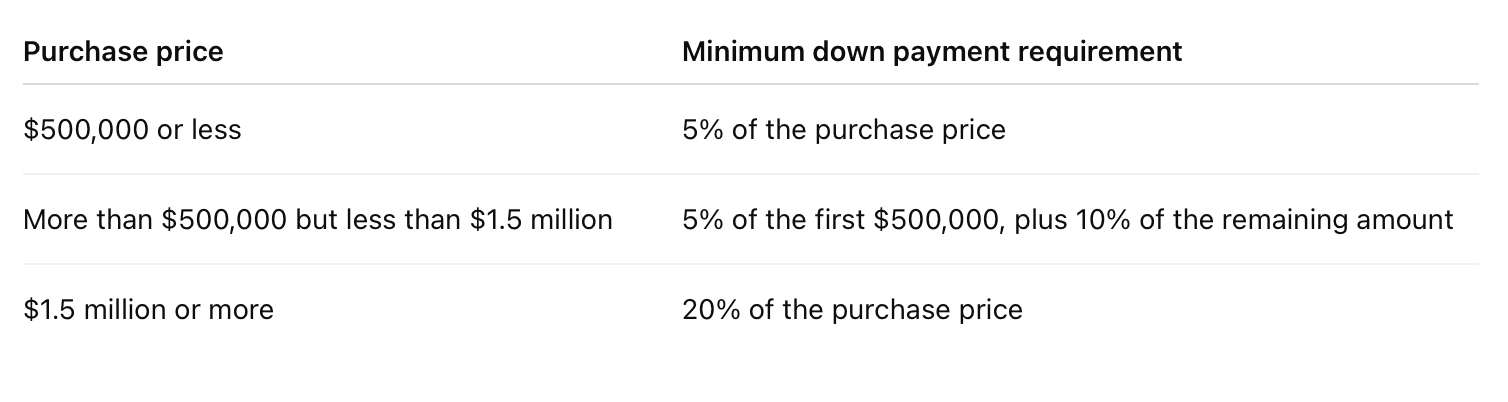
These are minimum requirements. Your lender may require more depending on your finances and the property. Purchases with less than 20% down generally require mortgage default insurance, which protects the lender. Its premium can usually be added to the mortgage, increasing your borrowing and payments.You can review the current rules through the Financial Consumer Agency of Canada’s down payment guide.
A larger down payment reduces the amount you borrow, but using every available dollar can leave you stretched after moving in. Compare your options with a mortgage professional and consider how much cash you want to retain.

To explore properties at different price points, browse Victoria condos for sale, Greater Victoria townhomes for sale or all Greater Victoria MLS® listings.
Is the Deposit Different From the Down Payment?
Yes, but the deposit normally becomes part of your down payment when the purchase completes.Your deposit is money paid according to the terms of your purchase contract, usually held in trust. Its amount and payment deadline are negotiated.Your down payment is the total amount you contribute toward the purchase price, with the rest generally financed through your mortgage.For example, if your total down payment is $40,000 and you have already paid a $20,000 deposit, the remaining down payment is $20,000. You still need separate funds for closing costs.The deposit is not an additional $20,000 on top of your $40,000 down payment. However, you must have it accessible by the contractual deadline.
For more information, see the BCFSA Consumer Guide to Deposits.
What Closing Costs Should You Budget For in Victoria, BC?
The cost to buy a first home in Victoria includes expenses beyond the price you negotiate with the seller.CMHC identifies approximately 1.5% to 4% of the purchase price as a general closing-cost planning range. Your actual expenses can differ considerably depending on tax exemptions, the property and the transaction. Use an itemized estimate rather than relying only on a percentage.
Start with my guide to buyer closing costs in BC, then obtain quotes for the services you will need.
BC Property Transfer Tax
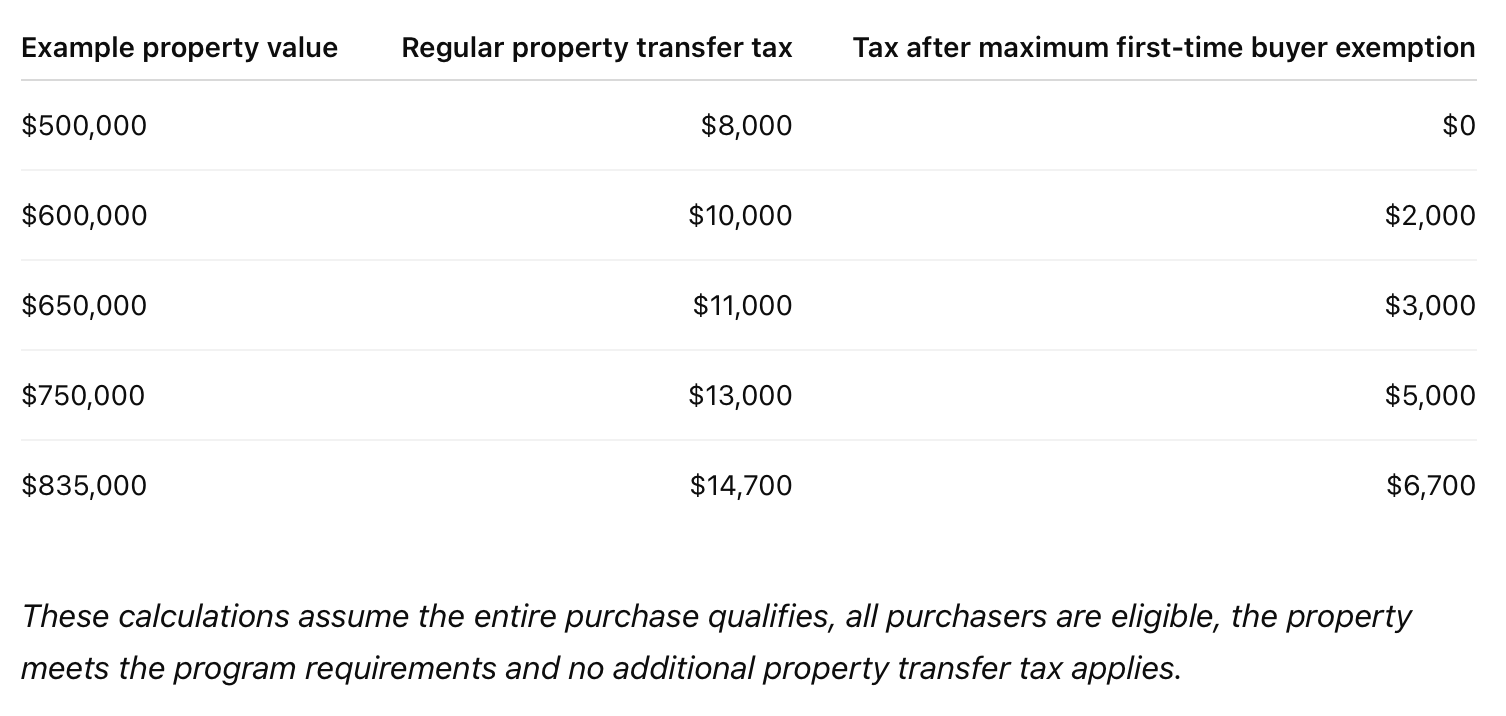
Property transfer tax can be a significant upfront expense, even for first-time buyers.Under the current BC First Time Home Buyers’ Program, eligible buyers can receive an exemption worth up to $8,000 on qualifying properties valued up to $835,000. A reduced exemption may apply above $835,000 and below $860,000.
A qualifying home priced below $835,000 is not automatically free of property transfer tax. For homes above $500,000, tax can remain payable after the exemption.
A qualifying home priced below $835,000 is not automatically free of property transfer tax. For homes above $500,000, tax can remain payable after the exemption.
Eligibility includes personal, residency, property and occupancy requirements. Your lawyer or notary should confirm your entitlement. Review the province’s First Time Home Buyers’ Program and official exemption amounts.
Legal or Notary Fees
Your lawyer or notary handles the legal completion of your purchase, including title transfer and mortgage registration.Ask for a written estimate that identifies professional fees, taxes, registration charges and disbursements. Confirm whether title insurance and any additional work are included.
Home Inspection and Additional Reviews
An inspection helps you understand the condition of the home before you commit to proceeding under your contract.The price depends on the property’s size, type and inspection scope. Additional investigations,
such as drainage, electrical or environmental assessments, may require separate specialists.
For condos and townhomes, you may also choose to budget for an independent strata document review.
My buyer closing-cost guide discusses these expenses, including indicative inspection and legal-fee ranges.
Adjustments, Insurance and Lender Costs
Your completion statement may include adjustments for expenses the seller has prepaid, such as property taxes or strata fees. You may also need an insurance payment, appraisal or other lender-related expense.Confirm these amounts early with your legal professional, insurer and mortgage provider.
Before signing a buyer representation agreement, also understand the agreed brokerage compensation and whether any portion could be payable directly by you.
Moving and Getting Settled
Allow room for movers, cleaning, utility connections, locks, strata move-in charges and immediate repairs. Furniture and decorating can follow later; essential expenses should already fit your budget.Buying new construction requires a separate tax review. Confirm whether GST is included in the advertised price and what exemptions or rebates apply before relying on a final cash estimate.
The $6,000 expense allowance and $10,000 reserve are planning assumptions, not quotes, lender requirements or amounts suitable for every buyer. Replace them with your own estimates. This example assumes full eligibility for the property transfer tax exemption and excludes unusual expenses or directly payable brokerage compensation.
A deposit paid toward this purchase would form part of the $35,000 down payment, it would not be added again.This is why having the minimum down payment saved does not necessarily mean you have enough cash to complete comfortably.

For the wider buying process, visit my First-Time Home Buyers Guide for Victoria, BC.
For a condo, the strata corporation’s insurance does not replace your personal insurance. Review your coverage with an insurer who understands strata properties.
Also distinguish between what a lender will approve and what feels comfortable in your household budget. Lenders may use only part of the strata fee in qualification calculations; you must pay the full fee.
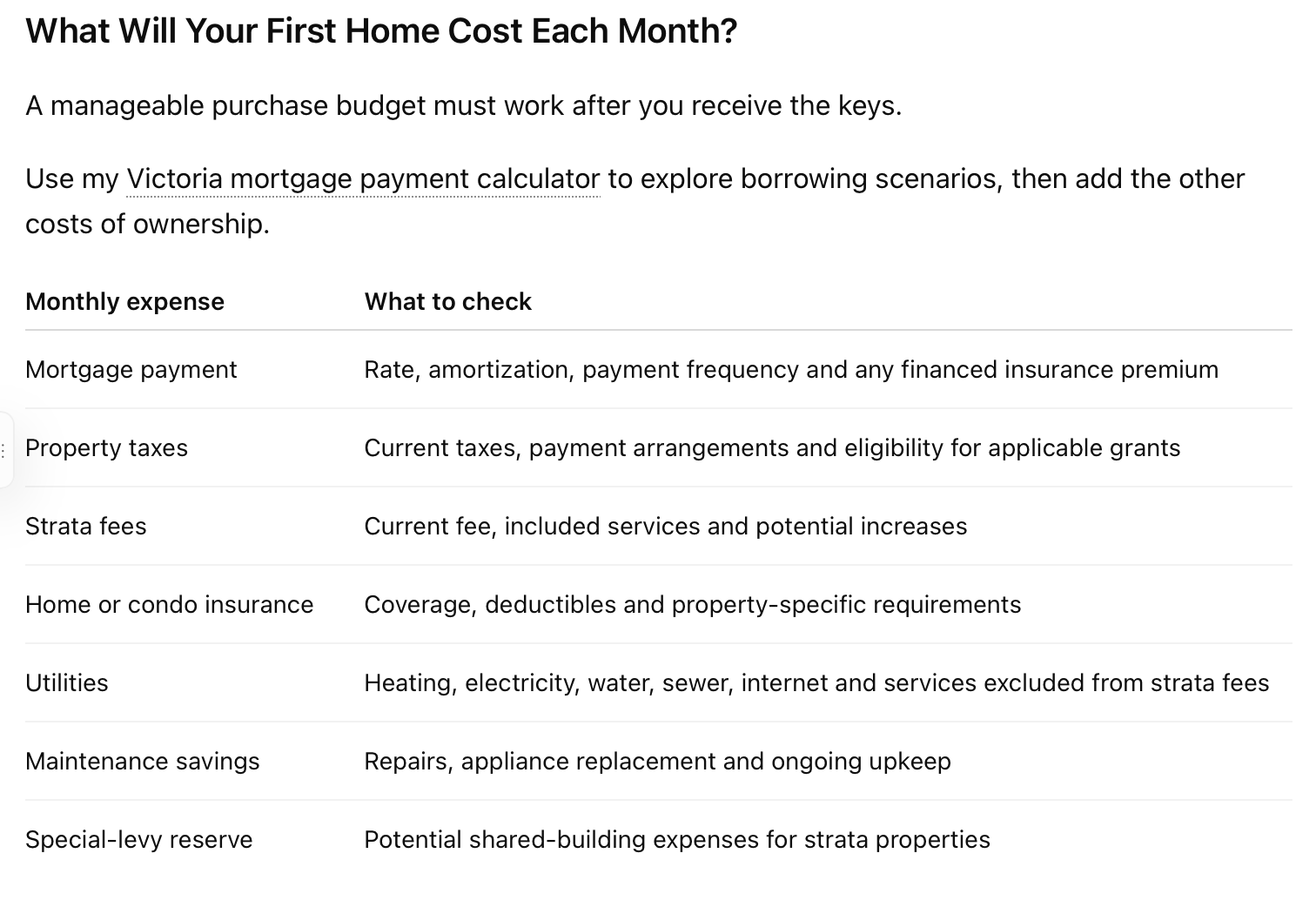
For a condo, the strata corporation’s insurance does not replace your personal insurance. Review your coverage with an insurer who understands strata properties.
Also distinguish between what a lender will approve and what feels comfortable in your household budget. Lenders may use only part of the strata fee in qualification calculations; you must pay the full fee.Does Location Change What You Can Afford?
Your purchase price matters, but so does the cost of living in that location.A smaller condo near work may reduce transportation expenses. A larger home farther away may offer more space while increasing commuting, fuel or vehicle costs.
Compare the full picture when exploring Victoria, Saanich, Esquimalt, Langford, Colwood, View Royal, Sidney or Sooke.
Read Affordable Places to Buy Near Victoria, BC, or compare current options through my Esquimalt home search and View Royal listings.
Your First-Home Savings Checklist
Before you begin actively viewing homes:- Speak with a mortgage professional. Confirm your borrowing options, down payment requirements and estimated payments.
- Choose a comfortable monthly budget. Include ownership costs alongside groceries, transportation, debt payments and regular savings.
- Separate your savings into three categories: down payment, purchase expenses and money retained after moving.
- Confirm deposit access. Check withdrawal and transfer timelines before agreeing to a payment deadline.
- Verify program eligibility. Investigate the First Home Savings Account and other applicable programs with qualified professionals.
- Gather financial records. Ask your lender what income documents and down payment history it needs.
- Obtain quotes. Contact a lawyer or notary, inspector, insurer and movers.
- Review property-specific expenses. Investigate taxes, strata finances, insurance and anticipated repairs.
- Protect your financing. Discuss new borrowing or employment changes with your lender before making them.
- Keep a cash cushion. Choose a reserve that reflects your income stability, household expenses and the property’s condition.
Frequently Asked Questions
Can I buy my first home in Victoria with 5% down?
Potentially. For an eligible home costing $500,000 or less, the minimum down payment is generally 5%. Above that price, the portion exceeding $500,000 requires 10% down until the purchase reaches the $1.5 million threshold. You must also qualify for financing and cover purchase expenses.Is $30,000 enough to buy a first home?
It depends on the purchase price, financing and other available funds. A $500,000 purchase requires at least $25,000 down, leaving $5,000 for other expenses if your total savings are $30,000. That could leave little room for closing costs and emergencies. Build an itemized budget before committing.Does mortgage pre-approval guarantee financing?
No. Final approval also depends on the property and your lender’s requirements. Confirm financing for the specific purchase before removing a financing condition.Should I wait until I have 20% down?
That decision depends on your savings, income, mortgage options, timeline and comfort with debt. Ask a mortgage professional to compare smaller and larger down payment scenarios, including insurance costs and the cash you would retain.Start Your First Home Search With a Clear Plan
You do not need to have every answer before reaching out. You need a starting point that connects your savings, monthly budget and housing priorities.As a Greater Victoria REALTOR®, I help first-time buyers understand their options, compare properties and prepare for the steps ahead.
Call 778-678-5466, explore my first-time buyer guide, or begin browsing homes for sale across Greater Victoria.
Information reflects sources reviewed in October 2026. Examples are for general planning. Confirm current financing, tax eligibility and transaction costs with your mortgage professional, lawyer or notary.
