

By Janine Thomson | Realtor | Pemberton Holmes
Greater Victoria and Vancouver Island Real Estate
If you own or are buying a home in Victoria, BC or Greater Victoria, you probably think about home inspections, insurance, plumbing, electrical systems, moisture and the condition of the foundation.But have you ever tested the home for radon gas?
If you own or are buying a home in Victoria, BC or Greater Victoria, you probably think about home inspections, insurance, plumbing, electrical systems, moisture and the condition of the foundation.But have you ever tested the home for radon gas?
Most homeowners haven't.
Radon is especially interesting because there is no obvious sign that it is present. You cannot see it, smell it or taste it, and a home can appear to be in excellent condition while still having an elevated radon level.
Greater Victoria and Vancouver Island have generally reported lower radon levels than some areas of Interior and Northern British Columbia. However, that does not mean every home in Victoria has low radon.Radon levels are property-specific, and the only reliable way to know the level inside a particular home is to test the home itself.
Free Printable Radon Homeowner Guide
Want to keep this information for future reference?I've created a free printable Radon Homeowner Guide for Greater Victoria homeowners and home buyers, including:
- How radon enters a home
- Where to place a radon detector
- How long to test
- Health Canada's 200 Bq/m³ guideline
- Radon test-kit options
- What happens if your result is high
- How professional radon remediation works
- Radon considerations for new BC homes
- A printable homeowner radon checklist
Save it with your home-maintenance records or share it with someone buying a home in British Columbia.
What Is Radon?
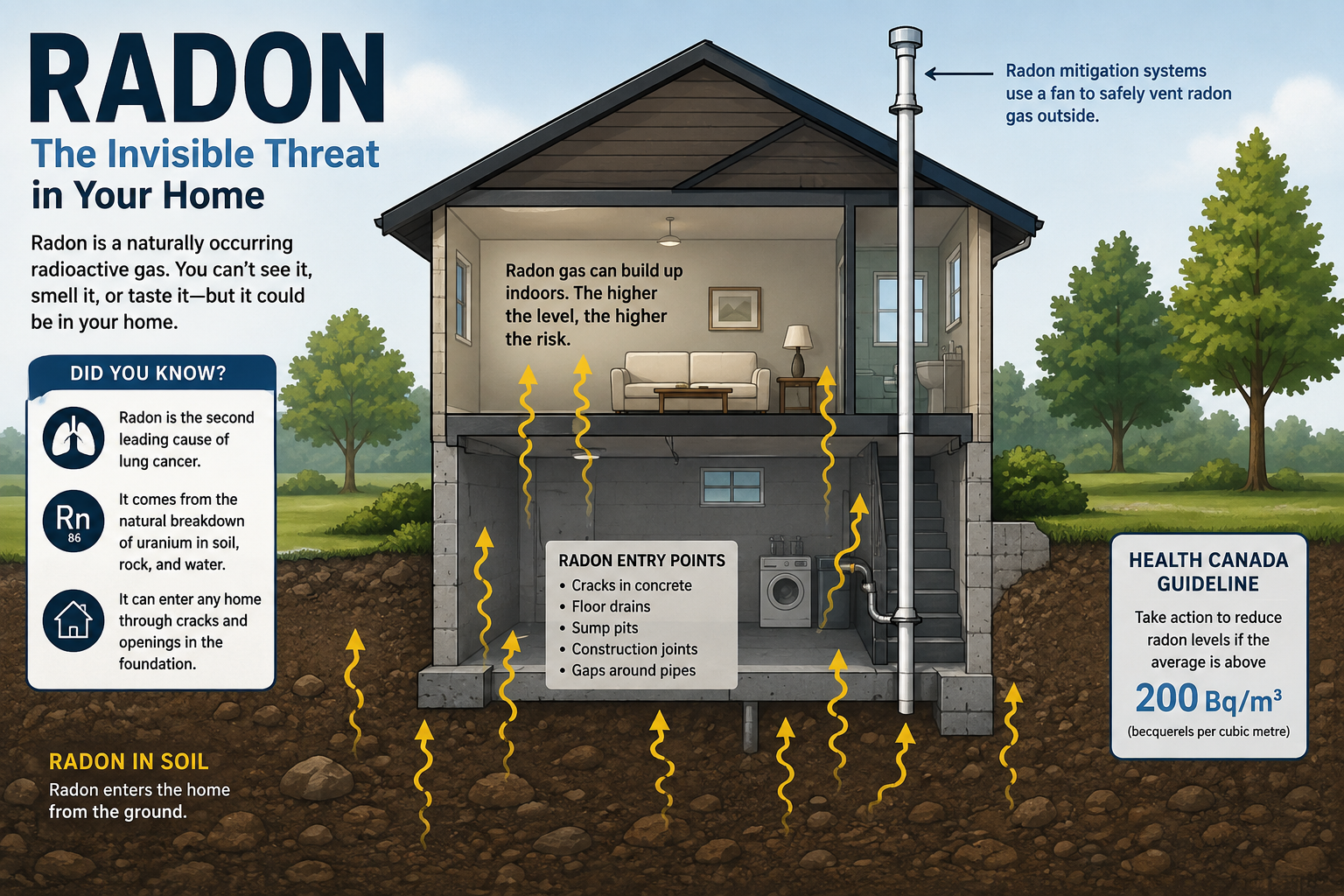
Radon is a naturally occurring radioactive gas created by the breakdown of uranium found in soil and rock.Outside, radon normally disperses into the atmosphere and is not usually a concern.The problem occurs when radon moves from the ground into a building and becomes concentrated inside.Radon can enter a home through:- Cracks in concrete foundations
- Cracks in basement floor slabs
- Construction joints
- Gaps around plumbing and utility penetrations
- Floor drains
- Sump pits
- Crawlspaces
- Slab-to-foundation-wall joints
- Other openings between the building and the soil
Can You Tell If a House Has Radon?
No.This is one of the most important things for Victoria homeowners and home buyers to understand.Radon:
Has no smell.
Has no colour.
Has no taste.
Doesn't leave a stain.
Has no colour.
Has no taste.
Doesn't leave a stain.
Doesn't necessarily cause a visible building defect.
A REALTOR®, homeowner or home inspector cannot walk through a property and determine its radon concentration by looking at the foundation.
The home needs to be tested.
That is also why your neighbour's radon result cannot tell you what is happening in your home.
Two houses beside one another can have different radon concentrations because indoor levels are influenced by soil conditions, foundation construction, ventilation, air pressure, weather and the pathways available for soil gas to enter.
If you're purchasing a property, radon is one of several environmental and building considerations worth understanding during your due diligence. My Greater Victoria Home Inspection Guide explains what a typical BC home inspection covers, what it doesn't cover, and when additional specialist investigations may be appropriate.
Is Radon a Problem in Victoria, BC?
This question requires some perspective.Greater Victoria and Vancouver Island are generally considered lower-radon areas compared with some regions of Interior and Northern BC.That is good news.But "lower risk" does not mean "no risk."
A regional average cannot tell you the radon concentration in an individual house in:Victoria, Saanich, Oak Bay, Esquimalt, View Royal, Langford, Colwood, Sidney, Central Saanich, North Saanich, Highlands, Metchosin or Sooke.
For homeowners, the more useful question isn't:"Does Victoria have radon?"
It is:"What is the radon level in my house?"
Testing answers that question.
What Types of Victoria Homes Should Be Tested?
Any home can be tested, regardless of its age.I would particularly consider testing when a home has occupied living space close to the ground, including:
- Finished basements
- Basement bedrooms
- Basement suites
- Lower-level family rooms
- Home offices in basements
- Crawlspaces
- Sump pits
- Foundation cracks
- Significant ground-contact living areas
New homes should not automatically be assumed to have low radon either.
More on that below.
How Do You Test a Home for Radon?
For homeowners who want to determine the radon level in their house, Health Canada recommends long-term testing.Radon levels naturally fluctuate throughout the day and throughout the year.
Weather, heating, ventilation, indoor/outdoor pressure differences and seasonal conditions can all affect measurements.
For that reason, a reading taken over a few hours or a couple of days doesn't provide the same information as a long-term measurement.
Health Canada's current residential guidance recommends testing for approximately 3 to 12 months, with at least 91 days of the measurement occurring during the heating season.
Where Should You Put a Radon Detector?
The detector should generally be placed on the lowest lived-in level of the home.Think about where people actually spend time.For example, if your basement contains a bedroom, family room or home office that is regularly occupied, the basement may be the appropriate testing level.
If the basement is unfinished and only used occasionally for storage or laundry, another occupied level may be more appropriate.
Follow the detector manufacturer's instructions and Health Canada's placement recommendations.
Generally, avoid putting the detector directly beside:
- Windows
- Exterior doors
- Heating or cooling vents
- Fireplaces
- Kitchens
- Bathrooms
- Laundry areas
- Major appliances
- Direct sources of heat or moisture
Can a Home Inspector Test for Radon Before You Buy a House?
Yes.Some qualified home inspectors offer radon measurement as an additional service, or a buyer can hire a C-NRPP-certified radon measurement professional.
The difficulty during a real-estate transaction is time.
A normal inspection and subject-removal period may only provide several days, while Health Canada's preferred testing period is measured in months.
A professional short-term radon screening test can still provide useful information during a real-estate transaction, but buyers should understand that it is not equivalent to a long-term test of the home's average radon concentration.
If you're preparing to purchase a house, condo or townhome, start with my Complete Guide to Buying a Home in Greater Victoria for a broader explanation of inspections, conditions, financing, due diligence and the buying process.
You can also read How to Buy a House in Victoria BC for my step-by-step 2026 home-buying guide.
What Radon Test Kits Can Homeowners Buy in Canada?
Testing doesn't necessarily require hiring someone.Homeowners can purchase a long-term test kit or a reusable electronic radon monitor and perform the test themselves.Here are three options to consider.1. Canada Radon AT-100 Long-Term Radon Test Kit
For homeowners who simply want to determine their long-term radon level without purchasing an electronic monitoring system, an alpha-track detector is a practical option.The detector remains in the home for the testing period and is then returned for laboratory analysis.At the time of research, the Canada Radon AT-100 was approximately $49.95 CAD.
Prices and availability can change, so confirm current information directly with the supplier.
2. Airthings Corentium Home Radon Detector
The Airthings Corentium Home is a reusable, battery-operated electronic radon monitor.Rather than sending a detector to a laboratory, you can monitor readings over time and watch the longer-term average.
At the time of research, Canadian pricing was approximately $179.99 CAD.
Search the Canadian Tire website for Airthings Corentium Home Radon Detector for current pricing and availability.
3. Ecosense EcoQube Radon Monitor
The EcoQube is another electronic monitoring option for homeowners who prefer continuous measurements.It uses Wi-Fi and app-based monitoring so homeowners can follow changes and longer-term radon trends.At the time of research, Canadian pricing was approximately $189 CAD.
When purchasing an electronic radon monitor in Canada, check that the model meets current C-NRPP performance-testing requirements rather than choosing an inexpensive online detector based only on customer reviews.
What Does a Radon Reading of 200 Bq/m³ Mean?
Health Canada's indoor guideline is:Below 200 Bq/m³
Corrective action is not required under the Canadian guideline, although reducing unnecessary radon exposure is still beneficial.200 Bq/m³ or Higher
Health Canada recommends taking action to reduce the radon concentration.The higher the radon concentration, the sooner remediation should be undertaken.Importantly, the guideline should be applied to a representative long-term average, not a single high hourly reading on an electronic detector.
What Happens If Your Home Tests High for Radon?
Finding elevated radon does not normally mean the home is permanently contaminated or that you need to replace the foundation.Radon is generally a manageable building-science problem.
Professional mitigation focuses on preventing soil gas from entering the living area.The most common technique is called active soil depressurization.
How Does Professional Radon Remediation Work?
For a home with a concrete basement or slab foundation, a qualified radon mitigation professional typically creates a suction point through the slab.A sealed pipe connects that suction point to a continuously operating radon fan.The fan creates negative pressure beneath the foundation.Instead of allowing radon-containing soil gas to enter the house through cracks and openings, the system captures the gas underneath the home and safely exhausts it outdoors.
In simple terms:
Soil beneath the home → suction point → sealed pipe → radon fan → exhaust outdoors
Professionals may also seal:
- Foundation cracks
- Slab joints
- Sump pits
- Plumbing penetrations
- Utility penetrations
What About Homes With Crawlspaces?
Homes with exposed-soil crawlspaces can also be remediated.A professional may install a durable sealed membrane over the exposed soil.
A suction system is then installed underneath the membrane so radon-containing soil gas is collected and exhausted outdoors before it reaches the living space.
This is commonly known as active sub-membrane depressurization.
Does the Home Need to Be Tested Again After Radon Remediation?
Yes.Testing after remediation confirms that the system is actually reducing the radon concentration.Ongoing testing is also important because homes change.
Renovations, foundation work, new windows, energy-efficiency improvements, HVAC changes and other alterations can change air pressure and ventilation patterns.
Health Canada recommends periodic retesting, including approximately every five years for homes with an active soil-depressurization system and after significant renovations or changes that could affect the building.
Do New Homes in BC Have Radon Protection?
This is where things become particularly interesting for people buying new construction homes in Victoria, BC.Builders generally cannot simply test the vacant lot before construction and accurately predict what the indoor radon concentration will eventually be.The finished home's construction, ventilation and pressure characteristics also influence the result.Instead, British Columbia has changed how applicable new homes are constructed.For applicable Part 9 projects with building permit applications made on or after March 8, 2024, the BC Building Code introduced province-wide requirements for a rough-in for a subfloor depressurization system.This infrastructure is intended to make future mitigation easier if testing after construction identifies elevated radon.
Depending on the building design, the system can include:
- A gas-permeable layer beneath the slab
- A sealed soil-gas barrier
- Radon piping
- Infrastructure that can be connected to an active fan if required
A newly constructed home should still be tested after occupancy.
If you're considering buying a new home, read my New Construction Homes in Victoria BC: Complete Buyer's Guide.
New-home buyers should also understand what is and isn't protected under BC's warranty program.
My Guide to the BC 2-5-10 Home Warranty explains those protections in more detail.
What About Radon When Selling a Home in BC?
There is an important distinction between a home that has never been tested and a home with a known elevated radon result.BCFSA provides specific guidance regarding radon and real-estate transactions in British Columbia, including disclosure considerations where elevated radon is known.
If you have an existing radon report and are preparing to sell your home, discuss it with your REALTOR® rather than deciding on your own whether it is relevant to the transaction.
The same principle applies to other property conditions. Understanding known defects, repairs, insurance concerns and inspection findings before listing can help avoid surprises after an offer has been accepted.
If you're considering selling, my Preparing Your Home for Sale in Victoria BC guide walks through repairs, preparation, documentation, staging and other steps to consider before going to market.
Owners of older Victoria homes may also want to read The Most Difficult Items in Older Homes That Affect Home Insurance Approval.
Should Greater Victoria Homeowners Test for Radon?
Greater Victoria is fortunate to have generally lower radon levels than some parts of British Columbia.But that doesn't tell us what's happening inside an individual house.A homeowner cannot determine their radon level by:- Looking at the foundation
- Asking the neighbour
- Considering the age of the house
- Assuming a newer home is protected
- Relying on the municipality's average
- Waiting for physical signs or symptoms in the building
For many homeowners, an approximately $50 long-term test is a relatively inexpensive way to obtain information about an invisible environmental condition that otherwise cannot be detected.
And if elevated radon is found, there are established professional methods available to reduce it.
Download My Free Greater Victoria Radon Homeowner Guide
I've put the most important information from this article into a printer-friendly Radon Homeowner Guide that you can download, save or print.The guide includes:
- Radon basics
- Greater Victoria considerations
- Testing instructions
- Detector placement
- Three testing options
- Health Canada's 200 Bq/m³ guideline
- New BC construction requirements
- Professional remediation methods
- A homeowner testing checklist
- Canadian radon resources
DOWNLOAD & PRINT THE FREE RADON HOMEOWNER GUIDE →
Keep a copy with your home-maintenance documents and consider sharing it with family or friends who own a home in British Columbia.Buying a Home in Greater Victoria?
Environmental concerns such as radon are one part of a much larger due-diligence process.A good home-buying decision involves understanding the property itself, its systems, inspection findings, insurance considerations, neighbourhood, title, financing, strata documents where applicable, and the terms and conditions of your purchase contract.
You can start with my Greater Victoria Home Buyer's Guide or read my detailed Victoria BC Home Inspection Guide.
If you're considering purchasing a home in Victoria, Saanich, Oak Bay, Esquimalt, View Royal, Langford, Colwood, Sidney, North Saanich, Central Saanich, Metchosin or Sooke, I'm always happy to answer your questions.J
anine Thomson, REALTOR®
Pemberton Holmes
Greater Victoria, British Columbia
Office: 778-678-5466
info@janinethomson.net
janinethomson.net
This article is provided for general educational purposes and is not medical, engineering, environmental, legal or property-specific advice. Radon guidance, building codes, product prices and regulations can change. Homeowners and buyers should consult Health Canada, BCCDC, C-NRPP and appropriately qualified professionals regarding their particular property.
Pemberton Holmes
Greater Victoria, British Columbia
Office: 778-678-5466
info@janinethomson.net
janinethomson.net
