

By Janine Thomson | Realtor | Pemberton Holmes
GREATER VICTORIA & VANCOUVER ISLAND REAL ESTATE
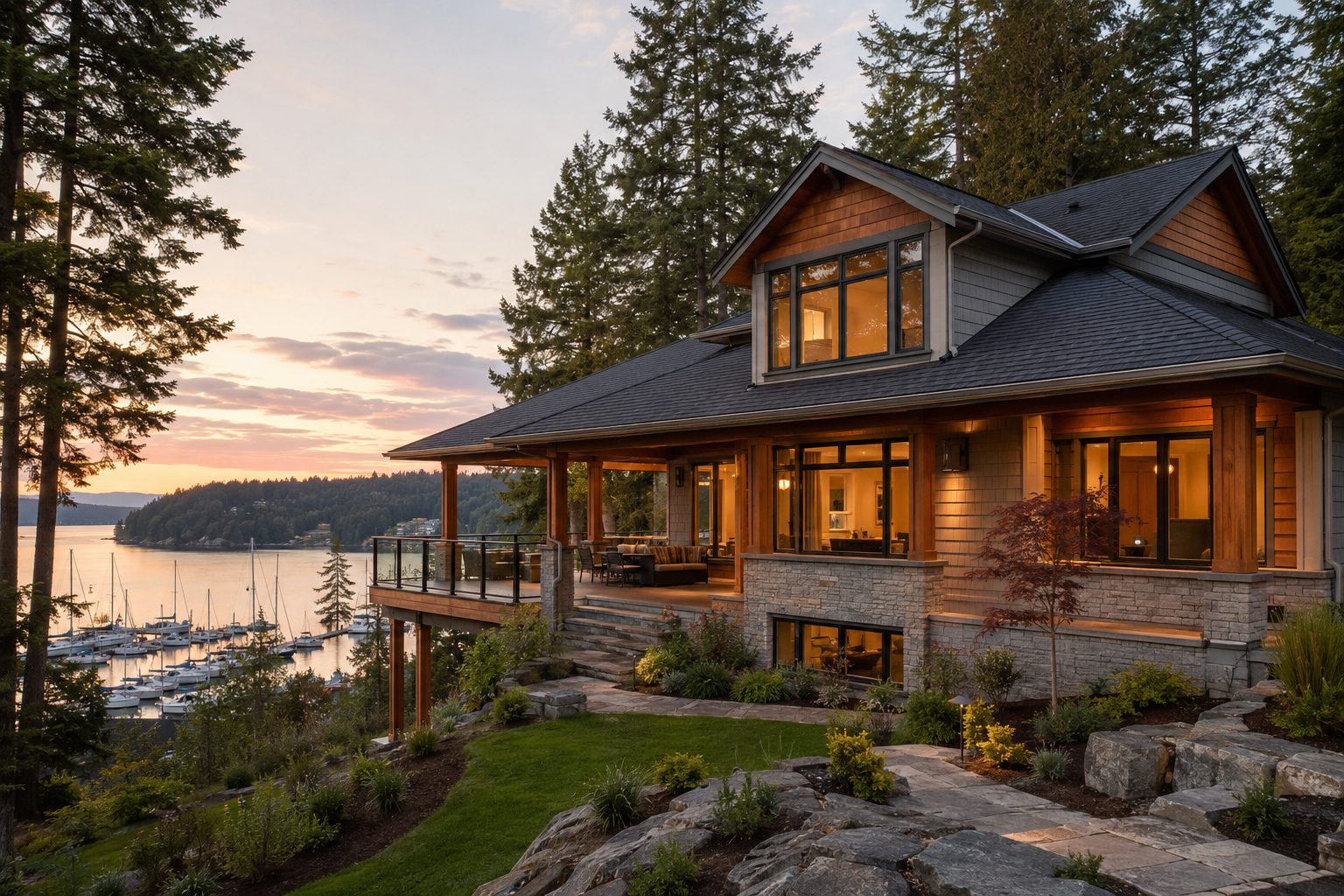
Buying a waterfront home in Victoria, British Columbia, is about much more than acquiring a beautiful house with an ocean view. It is a lifestyle purchase, a long-term investment and, in many cases, a more complex real estate transaction than buying a conventional residential property.
Greater Victoria offers some of the most desirable waterfront real estate on Vancouver Island. Buyers can find luxury oceanfront estates in Oak Bay and Ten Mile Point, beachside homes in Cordova Bay, private properties with docks in North Saanich, walkable waterfront condominiums in Sidney and James Bay, and dramatic coastal properties throughout Metchosin and Sooke.
The attraction is easy to understand. Waterfront homeowners may enjoy uninterrupted views, access to beaches and marine recreation, changing tides, spectacular sunsets and the opportunity to watch seals, otters, eagles and whales from home.However, the view is only one part of the purchase.
Waterfront buyers need to understand title boundaries, foreshore interests, docks, shoreline structures, erosion, drainage, coastal flooding, insurance, septic systems, wells, maintenance costs and municipal restrictions before removing conditions.
This guide explains what buyers should investigate before purchasing a waterfront home in Victoria, BC, and how to evaluate whether a particular property supports the lifestyle and level of responsibility they want.
Begin your research by exploring my Greater Victoria waterfront property and neighbourhood information, where you can compare coastal communities and learn more about the different types of waterfront living available throughout the region.
Why Victoria Waterfront Homes Are So Desirable
Waterfront real estate is limited by nature. New neighbourhoods can be created inland, but no one can create additional natural shoreline.That scarcity contributes to the long-term appeal of well-located waterfront properties, particularly when they offer privacy, usable outdoor space, protected views and convenient access to services.
Victoria waterfront homes may offer:
- Direct ocean or beach access
- Expansive views of the Salish Sea, Juan de Fuca Strait or local harbours
- Private docks or moorage opportunities
- Kayaking, paddleboarding and boating
- Wildlife viewing
- Privacy from neighbouring homes
- Strong lifestyle and luxury-market appeal
- Proximity to marinas, beaches and waterfront trails
These lifestyle benefits are real, but buyers should avoid allowing emotion to replace due diligence. A property can have a breathtaking view while also carrying expensive shoreline, drainage, insurance or structural obligations.
What Counts as Waterfront Property?
The term “waterfront” is sometimes used broadly in real estate marketing.A true waterfront property generally has land directly adjoining a body of water. However, not every waterfront property provides the same access, ownership rights or experience.Buyers may encounter several different categories.
Direct oceanfront homes
These properties generally border the shoreline and may offer beach access, rocky frontage, a bluff, a seawall or a dock.The nature of the shoreline matters. A gently sloping beach may provide easier access than a steep rock face, but it may also be more exposed to tides, storm activity or public access considerations.
Waterfront condominiums
Waterfront condominiums can offer exceptional views and a lower-maintenance lifestyle. They are found in areas such as James Bay, the Inner Harbour, Songhees, Sidney and parts of the Saanich Peninsula.Buyers must evaluate both the suite and the strata corporation. Building envelopes, underground parking, windows, balconies, insurance, seawalls and waterfront landscaping may create significant shared maintenance obligations.
My Victoria condo buyer resources explain what buyers should examine when reviewing strata documents, finances, insurance and depreciation reports.
Lakefront properties
Greater Victoria and nearby Vancouver Island communities also offer homes near lakes such as Elk Lake, Prospect Lake, Langford Lake, Glen Lake, Shawnigan Lake and other freshwater settings.Lakefront living differs from oceanfront living in terms of tides, salt exposure, shoreline use, water quality and recreational activity. Buyers should still confirm boundaries, dock permissions, environmental restrictions and flood considerations.
Water-view properties
A water-view home may provide beautiful ocean scenery without touching the shoreline. These homes can sometimes offer many of the visual benefits of waterfront living with fewer direct shoreline obligations.Buyers should verify whether the view is protected or whether future development, vegetation growth or construction could affect it.
Float homes
A float home is fundamentally different from a home located on waterfront land. Ownership, financing, insurance, moorage and maintenance can all be more specialized.My article on what it is really like to own a float home in Victoria and Vancouver Island explains the practical and financial considerations of this distinctive housing type.
The Best Areas for Waterfront Homes in Greater Victoria
Greater Victoria’s coastline is varied. Each community offers a different combination of scenery, accessibility, exposure, privacy and housing style.Oak Bay
Oak Bay is one of the region’s most prestigious waterfront markets. Areas near Beach Drive, Uplands, South Oak Bay and the Oak Bay Marina may offer ocean views, established luxury homes, rocky shorelines and access to beaches and golf courses.Many homes are older and may have been renovated over several decades. Buyers should review permits, electrical systems, drainage, foundations and building-envelope improvements carefully.
Oak Bay may appeal to buyers seeking an established municipality, mature landscaping and proximity to central Victoria.
Ten Mile Point and Cadboro Bay
Ten Mile Point offers some of Greater Victoria’s most dramatic waterfront estates. Properties may overlook Haro Strait, islands and distant mountain ranges.The terrain can include rocky outcrops, steep slopes and complex access. Geotechnical advice may be appropriate where a home is located near a bluff, retaining structure or shoreline slope.
Cadboro Bay offers a more village-oriented setting with beach access, local services and proximity to the University of Victoria.
Cordova Bay
Cordova Bay is known for sandy beaches, ocean views, golf and a quieter residential atmosphere. It is popular with families, retirees and buyers looking for coastal living within reasonable reach of central Victoria.Buyers considering Cordova Bay should evaluate shoreline exposure, drainage, slopes and the condition of older waterfront improvements.
North Saanich
North Saanich offers larger waterfront parcels, private settings, marinas and proximity to Victoria International Airport and BC Ferries.Properties may include wells, septic systems, docks, boathouses and outbuildings. These features can enhance the lifestyle but also increase the number of inspections, records and approvals a buyer should review.
Sidney
Sidney provides a more walkable waterfront experience. Buyers can find condominiums, townhomes and detached homes near marinas, waterfront paths, shops and restaurants.Sidney may appeal to retirees, downsizers, boaters and frequent travellers. My Sidney real estate and community guidecan help buyers compare the area with other coastal communities.
James Bay
James Bay offers waterfront proximity within walking distance of downtown Victoria, Beacon Hill Park, Fisherman’s Wharf and Dallas Road.Housing includes character homes, older strata buildings and newer condominiums. My article on why James Bay is a desirable place for waterfront living explores the neighbourhood’s combination of walkability, scenery and residential character.
Songhees and Victoria West
Songhees offers harbourfront condominium living close to downtown. Residents enjoy waterfront walkways, marina views and convenient access to the city centre.Buyers should study strata finances, parking, building-envelope history, windows, balconies and long-term waterfront maintenance obligations.
Metchosin and Sooke
Metchosin and Sooke provide a more rugged and rural waterfront experience. Properties may include acreage, forest, rocky coastline, private coves and exceptional ocean views.These locations can offer more privacy, but buyers should consider road access, emergency services, internet availability, septic systems, wells, shoreline stability and commute times.
For a wider comparison of coastal and inland communities, review my Best Neighbourhoods in Victoria, BC for Home Buyers.
Understand Exactly What the Property Title Includes
One of the most important waterfront-purchase questions is deceptively simple:Where does the private property end?
Many buyers assume ownership extends to the water or includes the beach directly in front of the house. That is not always the case.
In British Columbia, aquatic Crown land generally includes land below the natural boundary or high-water mark unless the title establishes otherwise. A waterfront owner may own the upland parcel but not the foreshore extending into the water.
The legal title, survey and natural boundary should be reviewed carefully. Buyers may need assistance from a lawyer, notary, surveyor or other qualified professional to understand where private ownership ends and Crown land begins.
Ask whether the property has:
- A current survey or site plan
- Natural-boundary information
- Registered easements
- Rights of way
- Restrictive covenants
- Encroachments
- Foreshore tenure
- Shared-access agreements
- Shoreline or environmental covenants
What Is a Foreshore Lease or Crown Tenure?
The foreshore is generally the area between the natural high-water boundary and the low-water mark.Waterfront owners may require permission or tenure to occupy or use aquatic Crown land for structures such as docks, floats, boat ramps or other improvements.
British Columbia provides policies and application processes for private moorage on aquatic Crown land. Depending on the structure and location, a dock may operate under a general permission or require a specific tenure.
Before purchasing, buyers should confirm:
- Whether a foreshore tenure exists
- What area and structures it covers
- Whether it is current
- When it expires
- Whether it can be assigned or transferred
- Whether annual fees apply
- Whether the structures comply with its terms
- Whether public access obligations exist
- Whether renewal is guaranteed
My detailed article on foreshore leases and waterfront properties in Victoria explains why these arrangements matter to buyers and sellers.
Do Not Assume a Dock Is Legal or Transferable
Private docks are among the most desirable waterfront features, particularly for buyers who boat, kayak or paddleboard.However, a dock can also create significant legal, environmental and maintenance questions.
Buyers should determine:
- Who owns the dock
- Whether permits or Crown authorization exist
- Whether the dock is included in the purchase
- Whether use is exclusive or shared
- Whether neighbours have access rights
- Whether the structure complies with current approvals
- Whether repairs or replacement will require new authorization
- Whether it is insured
- Whether navigation requirements apply
Within Esquimalt Harbour, federal requirements may also apply. A private dock or structure occupying federal Crown land within the harbour may require a Department of National Defence licence of occupation.
A marine contractor or structural specialist may be needed to assess pilings, floats, decking, hardware and exposure to storms or marine organisms.
Review Shoreline Structures Carefully
Waterfront properties may include seawalls, riprap, retaining walls, stairs, boat ramps and other shoreline improvements.These structures can be expensive to repair or replace. They may also require municipal, provincial or federal approval depending on their location and effect on the shoreline.
Ask for:
- Engineering reports
- Construction permits
- Maintenance history
- Contractor invoices
- Photos of prior work
- Information about erosion or past storm damage
- Estimates for anticipated repairs
Buyers should also understand whether neighbouring structures influence drainage, erosion or wave movement around the property.
Investigate Coastal Flooding and Tsunami Risk
Coastal properties may be exposed to storm surge, rising sea levels, wave action and tsunami hazards.The Capital Regional District has developed coastal flood-inundation mapping to provide regional information about flooding associated with sea-level rise and tsunamis.
The CRD also provides a tsunami information portal where residents can explore local hazard areas and identify potential evacuation routes.
Buyers should investigate:
- Whether the property is within a mapped coastal hazard area
- The elevation of the home and major systems
- Whether the municipality has flood-construction requirements
- Whether a basement or crawlspace has experienced water entry
- Whether shoreline structures have been damaged by storms
- Whether access roads could be affected by flooding
- Whether insurance coverage is available
A geotechnical engineer, coastal engineer or surveyor may be appropriate when the home is close to a bluff, steep slope, eroding bank or low-lying shoreline.
Confirm Insurance Before Removing Conditions
Insurance should be investigated early in the offer process.Waterfront homes may be more difficult or expensive to insure because of factors such as flood exposure, older construction, private docks, seawalls, oil tanks, remote fire protection, steep access or prior claims.
Buyers should provide the insurer with accurate information about:
- Property location
- Shoreline exposure
- Dock and marine structures
- Age of the home
- Electrical and plumbing systems
- Heating systems
- Roof condition
- Past claims
- Secondary suites
- Short-term rental use
- Wells and septic systems
An accepted mortgage does not guarantee that insurance will be readily available, and a lender may require adequate property insurance before advancing funds.
Use an Inspector Familiar With Coastal Homes
A standard home inspection remains important, but waterfront properties may benefit from inspectors and specialists familiar with coastal conditions.Salt air, wind and moisture can accelerate wear on:
- Metal fasteners and railings
- Exterior fixtures
- Windows and doors
- Siding
- Roofing materials
- Decks
- Balconies
- Heat pumps
- Dock hardware
My Victoria home inspection guide explains what a general inspection may include and when buyers should obtain further specialist review.
Depending on the property, additional inspections may include:
- Septic inspection
- Well-water testing
- Sewer scope
- Oil-tank scan
- Dock inspection
- Geotechnical assessment
- Engineering review
- Environmental assessment
- Arborist report
Septic Systems and Wells Require Separate Due Diligence
Many waterfront homes in North Saanich, Metchosin, Sooke and other rural areas rely on private septic systems and wells.The home inspection does not replace specialized septic or water testing.Buyers should request available records and investigate:
- Age and type of septic system
- Tank location
- Pumping history
- Permit records
- Signs of failure
- Replacement-area availability
- Well depth and construction
- Water quality
- Flow rate
- Water-treatment equipment
- Shared-well agreements
Understand Zoning and Future Development Restrictions
Buyers should never assume that a waterfront property can be expanded, subdivided or redeveloped simply because the lot is large.Municipal zoning, development-permit areas, environmental setbacks, flood-construction levels, covenants, tree-protection bylaws and shoreline regulations may limit what can be built.
Before purchasing, investigate whether your future plans may require approval for:
- Additions
- Guest houses
- Secondary suites
- Garages
- Pools
- Docks
- Shoreline stairs
- Retaining walls
- Tree removal
- Subdivision
- Vacation-rental use
Review View Protection and Neighbouring Properties
An ocean view can represent a significant portion of a property’s appeal and value.However, buyers should determine whether the view depends on:
- Trees located on neighbouring land
- Undeveloped lots
- Current zoning
- An informal agreement
- A public right of way
- A lower neighbouring building
- Vegetation maintained by another owner
Buyers should review nearby zoning, vacant parcels and development applications where future change could materially affect privacy or outlook.
Budget for Higher Maintenance Costs
Waterfront homes can require more frequent maintenance than inland properties.Buyers should plan for possible costs involving:
- Exterior painting and staining
- Window and door replacement
- Roof and gutter maintenance
- Deck repairs
- Corrosion control
- Seawall or shoreline work
- Dock maintenance
- Tree management
- Drainage improvements
- Septic servicing
- Well equipment
- Storm cleanup
The purchase budget should therefore include more than the down payment.Review my complete guide to buyer closing costs in Victoria, BC for a breakdown of Property Transfer Tax, legal fees, inspections, insurance and other expenses.
Buyers can also consult my How to Buy a House in Victoria, BC article for a broader explanation of financing, offers, subjects, title review and completion.
Consider Privacy, Public Access and Beach Use
Waterfront ownership does not always provide complete privacy.Depending on title boundaries and the physical shoreline, members of the public may use Crown foreshore areas. Crown tenure may also require public access to be maintained.Buyers should visit the property at different times and tidal conditions to understand:
- Whether people walk along the shoreline
- Whether boats anchor nearby
- Whether a public access point is close
- Whether neighbouring docks affect privacy
- Whether beach use changes seasonally
- Whether noise travels across the water
- Whether marine traffic is significant
Orientation and Exposure Affect Daily Life
Waterfront orientation influences sunlight, wind, temperature and views.An east-facing property may provide beautiful sunrises and morning light. A west-facing home may offer spectacular sunsets but experience stronger afternoon heat. Southern exposure may provide more sun, while a north-facing property may feel cooler and receive softer light.
Exposure also matters.An open-ocean property may experience stronger winds and wave action than a sheltered cove or harbour. Protected water may be better for docks and small boats but may have greater tidal flats, marine growth or seasonal activity.Visit the property in different weather and, where possible, at both high and low tide.
Evaluate Resale Value Beyond the View
Waterfront homes can remain highly desirable because of their limited supply, but not every waterfront property performs equally.Resale value may be influenced by:
- Quality and permanence of the view
- Privacy
- Shoreline usability
- Road access
- Condition of the home
- Legal status of docks and structures
- Insurance availability
- Exposure to flooding or erosion
- Proximity to services
- Lot size and topography
- Municipal restrictions
- Quality of renovations
Frequently Asked Questions About Victoria Waterfront Homes
Do waterfront homes cost more to maintain?
Often, yes. Salt air, moisture, wind, shoreline structures, docks and specialized systems can create higher maintenance requirements.Do I own the beach in front of my house?
Not necessarily. Ownership depends on the legal title and natural boundary. The foreshore may be Crown land even when the upland property is privately owned.Can I build a dock after buying?
Possibly, but approval is not guaranteed. Provincial, federal and municipal requirements may apply, along with environmental and navigational considerations.Does an existing dock automatically transfer with the property?
No. Buyers should verify ownership, tenure, permits, transfer requirements and whether the dock complies with existing approvals.Should I get a survey?
A current survey can be particularly valuable for understanding boundaries, encroachments, shoreline location and structures. Legal and surveying advice may be appropriate.Is flood insurance available for waterfront homes?
Availability and coverage vary. Buyers should obtain property-specific insurance advice before removing conditions.Are waterfront homes good investments?
They can offer strong long-term desirability because waterfront supply is limited. Investment performance still depends on location, condition, risks, market conditions and purchase price.Should I order a geotechnical inspection?
A geotechnical assessment may be advisable where the property includes steep slopes, bluffs, erosion, retaining structures or shoreline instability.Can waterfront homes have septic systems?
Yes. Many rural waterfront properties rely on septic systems. Buyers should arrange specialized inspection and investigate future replacement options.Are waterfront condominiums easier to own?
They may reduce direct exterior-maintenance responsibility, but the cost is shared through the strata. Buyers should carefully review the building’s financial and maintenance records.Work With Professionals Who Understand Waterfront Property
Waterfront purchases involve overlapping real estate, legal, environmental, engineering, insurance and municipal considerations.A buyer may need assistance from:
- A REALTOR® experienced with waterfront transactions
- A real estate lawyer or notary
- A home inspector
- A land surveyor
- A geotechnical or coastal engineer
- A marine contractor
- A septic professional
- A well or water-testing specialist
- An insurance broker
- Municipal and provincial authorities
Explore my Victoria buyer resources, learn more about making an offer on a home in Victoria, or search my Greater Victoria waterfront and residential listings.
Pemberton Holmes
About the Author
Janine Thomson, REALTOR® | ABR® | SRS®Pemberton Holmes
Janine Thomson is a Victoria REALTOR® serving buyers and sellers throughout Greater Victoria and Southern Vancouver Island, including Victoria, Oak Bay, Saanich, Cordova Bay, Ten Mile Point, North Saanich, Sidney, Esquimalt, View Royal, Langford, Colwood, Metchosin, Highlands and Sooke.
She assists clients with purchases and sales involving waterfront homes, luxury residences, condominiums, townhomes, detached homes, strata properties, acreages, land and relocation.
Janine’s approach emphasizes careful planning, local knowledge, thorough due diligence and clear communication throughout the real estate process.Learn more about Janine Thomson and her Greater Victoria real estate services or begin your search through her buyer resource centre.
Disclaimer
This article is provided for general educational and informational purposes only. It is not intended to constitute legal, financial, tax, environmental, engineering, surveying, insurance or investment advice.Waterfront properties are highly individual. Title boundaries, natural boundaries, foreshore interests, Crown tenures, docks, shoreline structures, zoning, environmental requirements, flood exposure, insurance availability and municipal regulations may vary by property and may change without notice.
Buyers should complete independent due diligence and obtain advice from appropriately qualified professionals before making a real estate decision. These professionals may include a licensed REALTOR®, lawyer or notary, surveyor, home inspector, engineer, environmental consultant, marine contractor, septic professional, insurance provider, mortgage professional and the applicable municipal, provincial or federal authority.
